
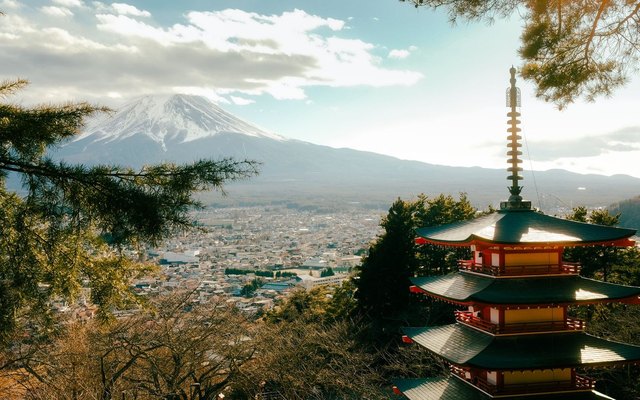
Source: Wikimedia Commons · Marion and Christoph Aistleitner, CC0
The mountain shows on about one morning in three, and it gives up a third of that by the afternoon. Fuji City has watched it from the same window three times a day since 1990: December is 61.7%, July 9.9%.
- Whole mountain at 8am, over 35 years
- 36.6% of mornings
- Best month
- December, 61.7%
- Worst month
- July, 9.9%
1A window somebody has been counting since 1990
A member of staff at Fuji City Hall has looked south at the mountain three times a day since May 1990 — 8am, noon and 4pm — from the eighth floor, and filed each look as whole, part visible or nothing. The published record runs to the end of 2025: 35 years, and 12,784 observations in the morning column alone.
The whole mountain was out on 4,684 of those mornings. That's 36.6%, near enough one morning in three. Add the mornings when only the summit or the foot showed and the share climbs to 58.9%.
| Month | Whole mountain at 8am | Partly visible | Nothing |
|---|---|---|---|
| January | 60.0% | 22.3% | 17.7% |
| February | 52.6% | 22.3% | 25.1% |
| March | 40.7% | 20.6% | 38.7% |
| April | 36.3% | 22.0% | 41.7% |
| May | 30.2% | 20.9% | 48.8% |
| June | 12.4% | 21.4% | 66.2% |
| July | 9.9% | 14.7% | 75.4% |
| August | 14.6% | 21.0% | 64.4% |
| September | 27.2% | 26.8% | 46.0% |
| October | 41.1% | 27.6% | 31.2% |
| November | 53.9% | 24.8% | 21.3% |
| December | 61.7% | 23.2% | 15.1% |
| All year | 36.6% | 22.3% | 41.1% |
The city's own reading of its table: the mountain shows most from November to February and least from June to August, with the spring haze of March to May and the typhoon season in September holding the numbers down as well.
One figure per month flattens the month. The city also keeps a day-by-day calendar of the same record, which is what to use if you're weighing the first week of a month against the last.
The most recent year, for comparison
2025 came in just above the long-run average: the whole mountain on 136 mornings of 365, against a 35-year mean of 134. August is the month that shows what the summer does to the odds.
| 2025 | Whole mountain | Partly visible | Nothing |
|---|---|---|---|
| January | 19 | 9 | 3 |
| February | 22 | 4 | 2 |
| March | 13 | 7 | 11 |
| April | 9 | 9 | 12 |
| May | 9 | 10 | 12 |
| June | 2 | 9 | 19 |
| July | 5 | 4 | 22 |
| August | 3 | 8 | 20 |
| September | 6 | 11 | 13 |
| October | 10 | 8 | 13 |
| November | 19 | 9 | 2 |
| December | 19 | 7 | 5 |
| Days | 136 | 95 | 134 |
The spread behind the headline number: 22 clear mornings in February, three in August. The month you book moves the odds more than anything you can do on the day.
2Morning is the half of the day that works
Across the same 35 years the whole mountain stood clear at 8am on 36.6% of days, at noon on 23.3% and at 4pm on 22.5%. Count a partial view and the three readings are 58.9%, 53.4% and 49.7%. The mountain loses roughly a third of its morning odds by the afternoon.
2025 shows how narrow the best window is: the whole mountain showed at all three hours on 62 days, and never showed at all on 77.
The summit builds its own cloud as the ground below warms, which is the usual explanation for the slide through the day. Whatever the cause, a coach that reaches the lake at 10:30 has already spent most of the day's odds.
3A clear sky isn't the same as a view
Fuji City counts clear mornings too, and the two columns don't move together. Over the 35 years January had 745 clear mornings at 8am and the whole mountain on 651 of them — close enough. June had 425 clear mornings against 130 full views, July 380 against 107, August 550 against 158.
Last year made the point in one month: 16 clear days in August, three of them with the whole mountain. The city's own note on the figures reads 晴天であっても、必ずしも富士山が見えるわけではありません — a plain blue sky is no promise of a visible mountain.
So a sunny forecast over the lake is a reason to go, not an answer. What the summit is doing sits in the checks further down.
4From Tokyo the same bet runs four times longer
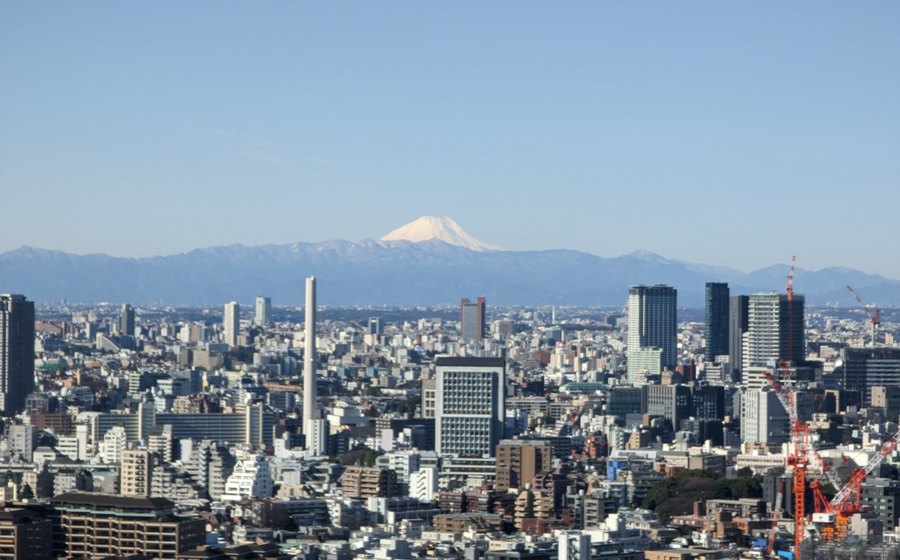
Source: Wikimedia Commons · Syced, CC0
Tokyo counts as well. The metropolitan government has photographed the mountain at 9am from its own building since 1992, the 35th floor to 2002 and the 31st from 2003, and the count before that came from the weather agency's Otemachi tower, at 10am, from 1971 to 1991. The average since 1992 is 95 days a year, about one in four.
| Month | Days the mountain showed |
|---|---|
| April | 4.9 |
| May | 4.2 |
| June | 1.8 |
| July | 2.4 |
| August | 1.7 |
| September | 2.9 |
| October | 5.8 |
| November | 11.3 |
| December | 18.1 |
| January | 19.1 |
| February | 13.6 |
| March | 9.4 |
| Year | 95.2 |
December and January carry that average, at about 19 days each, against fewer than two in August. The last two full years came in at 111 days and 115.
The building the count comes from is open to anyone, and the observatories on the 45th floor cost nothing. It's the cheapest Fuji morning on this page: a lift, a window and a 95 km line of sight.
Tokyo Metropolitan Government observatories 東京都庁 展望室
- Address
- 2-8-1 Nishi-Shinjuku, Shinjuku-ku, Tokyo · Map
- Phone
- +81 3-5320-7890 (observatory line, weekdays 10:00–17:00)
- Hours
- South observatory 09:30–21:30, north 09:30–17:00, or 22:00 when the south is closed; admission is free
- Closed
- South: 1st and 3rd Tuesday. North: 2nd and 4th Monday. Both close 29–31 December and 2–3 January
- Website
- yokoso.metro.tokyo.lg.jp
5The three checks worth making the night before
富士見予報, the Fujimi forecast
fuji-san.info scores the coming week from 1 to 10, morning and afternoon, for two directions of view: the north-east, which is the Fuji Five Lakes and the Tokyo side, and the south, which is Shizuoka. A high score means a better chance of seeing the mountain, not an empty sky — the page says so itself. It's rewritten around 4pm each day, which is the right hour to settle what tomorrow morning looks like. Japanese, English and Chinese versions all exist.
The live cameras
Yamanashi runs six: Fujiyoshida's own view, and one each over lakes Yamanaka, Kawaguchi, Shoji and Motosu, plus Fujigamine. Shizuoka runs eleven, from Shimizu Port and Fuji city round to the Satta pass, Nihon-daira and the prefecture's Mount Fuji World Heritage Centre. Both are free, and the reason to check one before you leave is that the camera settles in five seconds what the forecast argues about all morning.
Weather at the right altitude
A forecast for Kawaguchiko is a forecast for the town, and the summit sits about 2,950 m above it — 3,776 m above sea level against the lake's 830 m. Long-range charts describe the shape of a week, not a morning, so leave the decision to the index and the camera.
6When the white top arrives
初冠雪, the first snow cap, is called by the weather agency's Kofu office when the summit turns white as seen from about 40 km away. Three recent dates: 5 October 2023, 7 November 2024 (the latest since the record began in 1894) and 23 October 2025, which came 21 days behind the average date of 2 October.
As of 17 October 2026 the agency's summit page still read 積雪なし, no snow, a status it refreshes every hour at 25 minutes past. So the postcard version of the mountain, white cap over a dark base, rarely arrives before the second half of October, and from November you buy the cap and the better odds in the same trip. From July into early October the cap is gone altogether and the mountain is bare rock — the season the climbing routes open.
One change to know: from the 2027 cold season — the one that opened in August 2026, so the current one — the agency reads the cap from analysed snow depth rather than an observer's eyes, and warns that the two methods can't be compared like for like.
7North side, south side, and what each one gives you
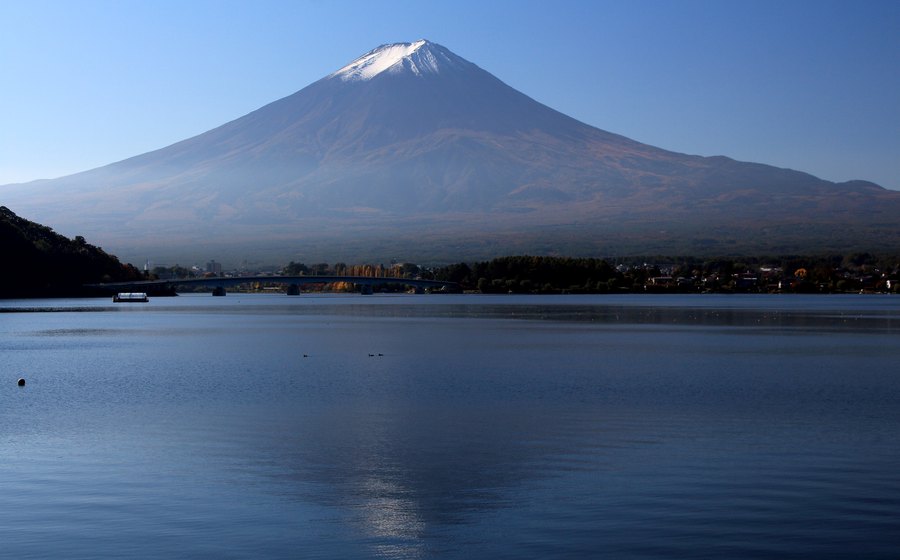
Source: Wikimedia Commons · Alpsdake, CC BY-SA 4.0
Yamanashi, on the north, is the lake side: Kawaguchi, Yamanaka, Shoji, Motosu and Sai, served by the loop bus and the ropeway, with the easiest train and coach access sitting at Kawaguchi. A reflection in the water wants a windless early morning, which is also the hour with the best odds. Motosu holds the view that ran on the old ¥1,000 note.
Shizuoka, on the south, looks across Suruga Bay: the pines of Miho no Matsubara, a component of the World Heritage listing and the subject of one of Hokusai's prints; the terraces at Nihon-daira; the Satta pass above the old Tokaido road; and Tanukiko inland, under the mountain's western slope.
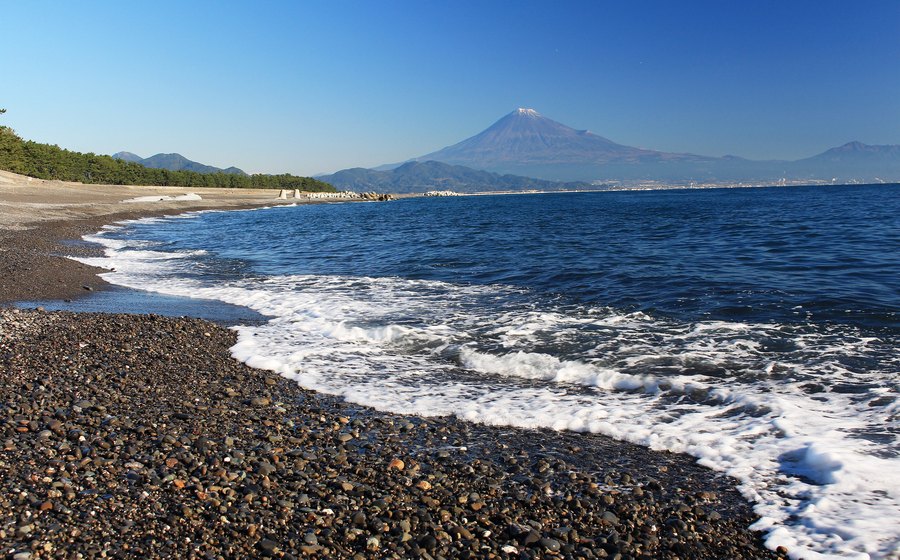
Source: Wikimedia Commons · Alpsdake, CC BY-SA 4.0
The south also gets a different card at each end of the year. Summer haze sits over the bay, and the clear air arrives with the late autumn, which is why a January morning works from the coast as well as from the lakes.
If you want the sun on the summit, the diamond, Tanukiko is the famous one: around 20 April and 20 August, give or take a week, at about 6am, with the sun doubled on the water.
Lake Tanukiko 田貫湖
- Address
- Sao 634-1, Fujinomiya, Shizuoka · Map
- Phone
- +81 544-27-5240 (Fujinomiya tourist association)
- Hours
- The lake is open at all hours; the campsite checks in 08:00–16:30 in summer and 08:00–15:30 in winter
- Closed
- No closing days; two car parks hold 40 and 200 cars, neither for buses
- Website
- city.fujinomiya.lg.jp
Miho no Matsubara 三保松原
- Address
- 1338-45 Miho, Shimizu-ku, Shizuoka 424-0901 · Map
- Phone
- +81 54-340-2100
- Hours
- 09:00–16:30 at the Mihoshirube centre; the pine shore itself is open at all hours
- Closed
- Open every day; parking for 173 cars
- Website
- visit-shizuoka.com
Keep reading Tokyo to Kawaguchiko: four trains each morning, and the bus
8What I would book
November to February, two mornings rather than one, and a bed on the water. The first Fujikyu train out of Shinjuku reaches the pagoda's station before 9:30, and the highway coaches get to the car parks an hour later, so the lakeside night is what buys you the hour that matters.
If the first morning is a write-off, the index resets in the afternoon and the next day is a fresh bet. By seven the cameras have told you whether the walk to the deck is worth it, and by nine the mountain itself has usually answered.
| For the Fuji morning | Why it belongs here | Check tickets |
|---|---|---|
| Tokyo hotel, near Shinjuku | The 07:30 express leaves from Shinjuku, and a late arrival the night before ruins the only hour that matters | Trip.com Klook KKday |
| Seat on the Fuji Excursion, or the highway coach | Four expresses a day and every seat reserved; November and February mornings go first | Trip.com Klook KKday |
| Data for the road | The index and the six Yamanashi cameras are the whole morning check, and both want a browser | Trip.com Klook Airalo |
9Questions and answers
The questions that come up most about choosing a morning for the mountain, from the month to the snow cap.
Which month should I pick?
December and January, at 61.7% and 60.0% of mornings across the 35-year record, with November and February in the fifties. July is the worst of the twelve at 9.9%, and June and August sit near it.
Is a morning really better than an afternoon?
Yes, and by a wide margin: 36.6% of mornings in the record showed the whole mountain against 22.5% of 4pm observations. The noon reading, 23.3%, is nearly as low.
Can I see Mount Fuji from Tokyo?
On about one morning in four. The metropolitan government's count from its own tower averages 95 days a year since 1992 — roughly 19 days in January and fewer than two in August. The observatory that the count comes from is free.
The forecast says sunny. Isn't that enough?
No. Clear skies and sightings don't track each other: over 35 years, June brought 425 clear mornings and 130 full views, and August 550 and 158. The summit makes its own weather.
Do I need a car?
No. The Fujikyu line and the highway coaches run from Shinjuku to Shimoyoshida and Kawaguchiko, and the loop bus covers the north shore. A car only helps on the Shizuoka side, where the viewpoints sit tens of kilometres apart.
When does the snow cap appear?
The first cap is usually called in the second half of October. It came on 23 October in 2025 and on 7 November in 2024, the latest since 1894. The weather agency's page shows the summit's snow status every hour.
Keep reading


Sources
- Fuji City, City Promotion Division — Mount Fuji observation record, 2025 report and the observation pages: three readings a day (8am, noon, 4pm) from the eighth floor of the city hall since May 1990; the 35-year totals to 2025 (12,784 morning observations, 4,684 with the whole mountain, 2,850 partly visible, 5,250 with nothing); the month-by-month and hour-by-hour tables; the clear-day counts set beside the sighting counts; the 2025 monthly figures including 16 clear days and three full views in August (city.fuji.shizuoka.jp).
- Fuji City — the day-by-day calendar of how often the mountain showed on each date of the year, built from the same record with the help of Numazu College of Technology (city.fuji.shizuoka.jp).
- Tokyo Metropolitan Government, Bureau of Environment — the Mount Fuji visibility count taken at 9am from the government's own building since 1992, the 35th floor to 2002 and the 31st from 2003, and before that from the Japan Meteorological Agency's Otemachi building at 10am, 1971–1991: the monthly averages used here, the 2024 and 2025 totals, and the note that the average is taken from 1992 onwards (taiki.kankyo.metro.tokyo.lg.jp).
- Japan Meteorological Agency — first snow cap (初冠雪) records and the current summit snow status: the Kofu office as the observing station for Mount Fuji, the switch to analysing snow depth from the 2027 cold season, the hourly refresh, and the 17 October 2026 reading of no snow (data.jma.go.jp/stats/data/mdrr/fsn_cap/).
- First-snow dates as announced by the Kofu Local Meteorological Office: 5 October 2023, 7 November 2024 (the latest since records began in 1894) and 23 October 2025, against an average date of 2 October.
- Fujimi forecast (富士見予報, fuji-san.info) — the 1–10 index for a view from the north-east and from the south, morning and afternoon, the note that the index measures the chance rather than the cloud, and the daily rewrite around 16:00.
- Yamanashi Prefecture — the Mount Fuji live camera page: the Fujiyoshida view and the cameras at lakes Yamanaka, Kawaguchi, Shoji and Motosu and at Fujigamine (pref.yamanashi.jp/livecamera).
- Shizuoka Prefecture — the Mount Fuji live camera map listing eleven cameras, from Shimizu Port and Fuji city to the Satta pass, Nihon-daira and the Mount Fuji World Heritage Centre (pref.shizuoka.jp).
- Fujinomiya City and the Fujinomiya tourist association — Lake Tanukiko: the address and the tourist association's phone number, the campsite check-in hours, the car parks, the double diamond around 20 April and 20 August within a week either side, and roughly 6am (city.fujinomiya.lg.jp, fujinomiya.gr.jp).
- Shizuoka City — Mihoshirube, the Miho no Matsubara cultural centre: address, phone, 09:00–16:30 opening, no closing days and the 173-space car park (city.shizuoka.lg.jp, miho-no-matsubara.jp).
- Tokyo Metropolitan Government, Bureau of Finance — the observatory guide: opening hours for the north and south halls, the monthly closing days, the year-end closure, free admission and the observatory information line (yokoso.metro.tokyo.lg.jp).
- Opening hours, fares, phone numbers and closing days are current as of 17 October 2026.