
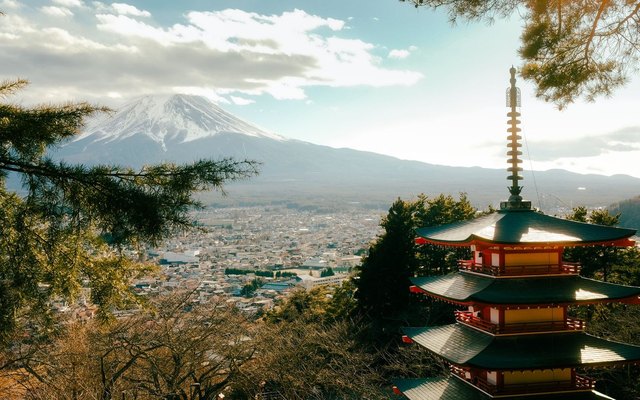
Source: Wikimedia Commons · Charlie fong, CC BY-SA 4.0
Hakone is one valley with five rides stacked up it, and the day only works in one direction: the mountain railway up, the ropeway over the crater, the boat across the lake, the bus back. The pass that covers all of it costs ¥7,100, and the ropeway shuts at five whether you're through it or not.
1What the day costs
Odakyu sells the Hakone Freepass in two shapes. From Shinjuku the adult pass is ¥7,100 and the child pass ¥1,600, valid for two days; bought for the Hakone area alone it starts at ¥6,000. It covers eight rides: the mountain railway, the cable car, the ropeway, the pirate ship and three bus services. It also takes a discount at about seventy baths, museums and gardens. A seat on the Romancecar isn't part of it.
Bought one leg at a time, the classic loop comes out like this:
| Leg | Single adult fare | What it's |
|---|---|---|
| Hakone-Yumoto to Gora | ¥460 | The mountain railway, 8.9 km |
| Gora to Sounzan | ¥430 | The cable car, one short pull |
| Sounzan to Togendai | ¥2,000 | The ropeway, the whole line |
| Togendai to Moto-Hakone | ¥1,700 | The pirate ship, one way |
| Those four together | ¥4,590 | Before the bus back to the station |
The ropeway fare is flat. A single hop from Owakudani to Ubako costs the same ¥2,000 as the whole four kilometres, so nobody should buy it in pieces; a return is ¥3,000 against ¥1,000 for a child. The boat is ¥1,700 one way between Togendai and Moto-Hakone and ¥3,000 return, and a seat in the special cabin adds ¥800 each way.
Add the bus down from Moto-Hakone and those four legs sit close to the ¥6,000 area pass on their own. Ride any leg twice and the pass is the cheaper way to do the day, which is the case it's priced for. Two days settle it: the day you buy the pass counts as day one and it runs to the last service the following day, so a night in the valley gets a second day of transport for nothing.
2The trains from Shinjuku
Two trains come down the Odakyu line to Hakone-Yumoto. The Romancecar is all reserved and takes about eighty minutes; on top of the fare it wants a limited express ticket of ¥1,200, or ¥2,400 for the return, and the EMot online ticket is ¥50 cheaper each way. The ordinary express runs the same line in about two hours on the fare alone, with no reserved seat and standing room when the school groups are aboard.
Pass holders pay the express ticket separately, which is why Odakyu's own return arithmetic from Shinjuku lands at ¥9,500: ¥7,100 for the pass and ¥2,400 for two seats on the fast train.
A ticket can be changed to another train only before departure and only if a seat is free, and a refund before departure costs ¥100. Miss the train and the ticket is gone, which is worth knowing on the way home when the last useful departure is at 19:50.
Coming from the Kansai side, the Shinkansen stops at Odawara, and the area-only pass at ¥6,000 is the one to buy there. It carries the same eight rides; the Odakyu leg between Odawara and Shinjuku is what the Shinjuku version adds.
3The loop in one direction
The mountain railway leaves Hakone-Yumoto and climbs 8.9 km to Gora in about forty minutes, on a gradient of 80 per mille, reversing on the way up. Sitting on the downhill side gets you the view over the valley; the uphill side gets the rock face.

Source: Wikimedia Commons · Joli Rumi, CC BY-SA 4.0
At Gora the cable car takes over for the last pull to Sounzan, ¥430 and ten minutes in a car that climbs the mountain in a straight line. Sounzan is the start of the ropeway: three sections to Togendai on the lake, about ten minutes each in an eighteen-seat gondola leaving roughly every minute. Owakudani, in the middle, is a change of platform rather than a change of line.

Source: Wikimedia Commons · Joli Rumi, CC BY-SA 4.0
From Togendai the pirate ship runs down the lake in 25 to 40 minutes, depending on which port you get off at. Moto-Hakone is the useful one: the shrine's torii stands in the water a short walk from the pier, and the buses back over the ridge to Hakone-Yumoto leave from the same place.

Source: Wikimedia Commons · Guilhem Vellut, CC BY 2.0
Run in that order, the transport alone is about two hours of sitting and standing, before a single stop. A loop with an hour at Owakudani and an hour at the shrine comes in around five.
4The hour the day has to be over
The ropeway runs 9:00 to 17:00 from February to November, and 9:00 to 16:15 in December and January. That closing time is the deadline the whole day hangs on: the last gondola down from Owakudani leaves before it, so a late start on the railway side turns into a rushed crater or a missed lake.
But the line stops for weather too. Strong wind, thunder and an approaching typhoon will shut the gondolas, and the operator suspends them when the volcanic gas reading at Owakudani climbs — the reading sits on the ropeway's own site and can move inside a morning. When the line is out, the loop reverses: bus from Moto-Hakone or Togendai, or give the crater up.
5The ropeway comes apart this winter
Odakyu Hakone takes the ropeway out in two pieces for its periodic inspection this winter, and runs buses over the missing sections in its place.
| Dates | Section out | What replaces it |
|---|---|---|
| 7 to 24 December 2026 | Owakudani to Sounzan | Bus, about 10 minutes, roughly every 15 minutes |
| 12 January to 26 February 2027 | Togendai to Ubako to Owakudani | Bus, about 15 minutes, roughly every 15 minutes |
The Freepass is valid on those buses. Anyone without a ropeway ticket rides the Izuhakone bus instead, and pays. Either way the gondola views over the crater go, the road buses queue behind the same traffic everyone else does, and the loop wants an extra half hour in the plan.
6An hour-by-hour day from Shinjuku
The 8:00 Romancecar from Shinjuku reaches Hakone-Yumoto at 9:24. That puts you on the mountain railway before ten, at Sounzan by eleven, and at Owakudani with the crater to yourself before the tour buses arrive. The last comfortable train back is the 19:50, which lands in Shinjuku at 21:26; anything after that's a local stopping everywhere.
The squeeze is between the lake and the railway. Moto-Hakone to Hakone-Yumoto is a bus over the ridge, and the pier, the shrine and the bus stop are all within ten minutes of each other — which is why the shrine gets an hour and Sengokuhara, on the other side of the ridge, usually doesn't.

Source: Wikimedia Commons · Guilhem Vellut, CC BY 2.0
If the day has a night behind it, the second day is the one the pass was really priced for: the bath houses at Tonosawa and Kowakidani, the museums along the ridge road, and a slower run at the lake. The pass still covers every bus and every ride, and the trains back to Tokyo are the same ones.
| For the Hakone day | Why before you go | Check tickets |
|---|---|---|
| Tokyo hotel near Shinjuku | The 8:00 departure leaves from Shinjuku, and the Odakyu terminal sits on the west side of the station | Trip.com |
| Fuji and Hakone day tour | For anyone who wants the loop driven rather than worked out, the coach does both in one day and skips the timetable | Trip.com Klook KKday |
| Japan eSIM | The ropeway's gas reading and the day's operating status are published on the operator's site, and they change inside a morning | Airalo |
| Left luggage | A suitcase has no place on a switchback railway and a gondola; a locker at Shinjuku buys you the whole loop | Radical Storage |
7Questions and answers
The day-trip arithmetic, the seat on the train, and the two closures.
Can Hakone be done as a day trip from Tokyo?
Yes, in one long day. The 8:00 Romancecar from Shinjuku reaches Hakone-Yumoto at 9:24, the loop of railway, cable car, ropeway and boat takes about two hours of travelling, and the last useful train back leaves at 19:50 and reaches Shinjuku at 21:26. Two stops — the crater and the shrine — fit around that. A third usually doesn't.
Is the Hakone Freepass worth it for one day?
For a single loop, roughly. The four legs cost ¥4,590 bought one at a time and the area-only pass is ¥6,000, so the pass needs the bus back from Moto-Hakone plus one repeat ride before it's ahead. Ride the ropeway or the boat twice, which most people do, and it wins. It's also the cheaper way to include a second day, since the pass covers the day after purchase for nothing.
Does the Freepass include the Romancecar?
No. The pass covers the eight local rides and the Odakyu line as far as your departure station, once each way. A Romancecar seat is a limited express ticket of ¥1,200 each way, or ¥2,400 return, and the EMot online price is ¥50 lower per leg.
How long does the whole loop take?
About two hours in transit: forty minutes on the mountain railway, ten on the cable car, thirty on the ropeway and 25 to 40 on the boat. With an hour at Owakudani and an hour at Hakone Shrine, plan on five hours in the valley, which is what makes the 8:00 train the one to take.
What happens if the ropeway shuts?
The operator suspends the gondolas for strong wind, thunder and typhoons, and when the volcanic gas reading at Owakudani rises. Bus services run the same corridor over the ridge, and the winter inspection closures are already scheduled with substitute buses. When the line is out, reverse the loop and treat the crater as the part you may lose.
When does the ropeway close in winter?
At 16:15 between December and January, and at 17:00 from February to November. In the coming winter two sections are also out for inspection: Owakudani to Sounzan from 7 to 24 December 2026, and Togendai to Owakudani from 12 January to 26 February 2027, both replaced by buses.
Keep reading


Sources
- Odakyu Electric Railway — Hakone Freepass: the adult pass at ¥7,100 and the child at ¥1,600 from Shinjuku, valid for two days and covering eight rides with discounts at about seventy facilities; the Hakone area-only pass at ¥6,000; the ¥9,500 return arithmetic with two Romancecar seats; that the Odakyu line section is one round trip with stopovers allowed on request; that the purchase date counts as day one and validity ends after the last service on the following day rather than after 48 hours; that the pass is collected at the finishing station; and that a ride on a suspended service is refunded at that station only if it was never used (odakyu-global.com/passes/hakone-freepass)
- Odakyu Electric Railway — Limited Express Romancecar: the ¥1,200 adult and ¥600 child express ticket from Shinjuku to Hakone-Yumoto on top of the ordinary fare, the ¥2,400 return, the ¥50 saving on an EMot online ticket, about 80 minutes against about two hours on an ordinary express, all seats reserved, changes only before departure and only with a free seat, and the ¥100 refund handling fee (odakyu-global.com/passes/romancecar)
- Odakyu Electric Railway — Romancecar timetable of 14 March 2026: the 08:00 departure from Shinjuku reaching Hakone-Yumoto at 09:24, and the 19:50 return reaching Shinjuku at 21:26 (odakyu-global.com/passes/romancecar, Shinjuku to Hakone-Yumoto tables)
- 箱根ナビ, the Odakyu Hakone group's own site — fares current as of 29 October 2026: the mountain railway matrix with Hakone-Yumoto to Gora at ¥460 adult and ¥230 child and Hakone-Yumoto to Sounzan at ¥890; Gora to Sounzan at ¥430 and ¥220 on the cable car; the ropeway's flat ¥2,000 one way and ¥3,000 return, child ¥700 and ¥1,000, with intermediate stops allowed; the cruise at ¥1,700 one way and ¥3,000 return between Togendai and Moto-Hakone, ¥600 between Moto-Hakone and Hakone-machi, and ¥800 one way for the special cabin; the 8.9 km, forty-minute, 80 per mille mountain railway; the ropeway at four kilometres over three sections of about ten minutes each with eighteen-seat gondolas about a minute apart; the cruise at 25 to 40 minutes between Togendai and the two lake ports; ropeway hours of 9:00 to 17:00 from February to November and 9:00 to 16:15 in December and January (hakonenavi.jp/transportation/ticket_info/fee and /hakone-ropeway)
- Odakyu Hakone — notice of ropeway periodic inspection, 9 July 2026: the Owakudani to Sounzan section suspended from 7 to 24 December 2026 for 18 days and Togendai to Ubako to Owakudani suspended from 12 January to 26 February 2027 for 46 days, substitute buses at about 10 and 15 minutes one way roughly every 15 minutes, Freepass and other ropeway tickets valid on those buses, and Izuhakone bus for anyone without one (hakonenavi.jp/groupnews/6027)
- Odakyu Hakone — Hakone Tozan Bus timetable revision of 1 October 2026, and the ropeway's published volcanic gas reading with its rule that a suspension is decided on several measurements (hakonenavi.jp/groupnews/17654 and /hakone-ropeway)
- Photographs: Lake Ashi, the shrine gate and the lake boat, Charlie fong, Guilhem Vellut; the mountain railway and the Owakudani ropeway, Joli Rumi — all via Wikimedia Commons, CC BY-SA 4.0 and CC BY 2.0