
Source: Wikimedia Commons · CC BY-SA 4.0
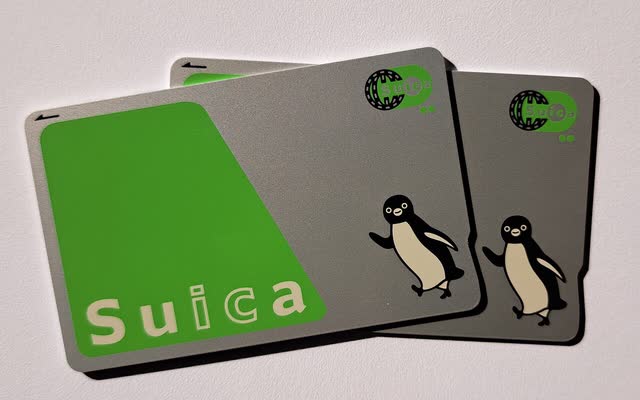
A Suica is the prepaid card you tap on gates, buses and convenience-store tills. Three versions exist in 2026; only the iPhone one takes a credit card.
1What a Suica costs
Most machines sell the card for ¥2,000: ¥500 deposit, ¥1,500 to spend. Others offer ¥1,000, ¥3,000, ¥4,000, ¥5,000 or ¥10,000, same ¥500 inside, cash only. Buy at a JR East machine or Midori-no-madoguchi, anywhere in the Tokyo, Sendai, Niigata and Sapporo areas.
Plain Suica went back on sale on 1 March 2025, after a two-year chip shortage. Any guide telling you to hunt for a card is out of date, and the deposit comes back when you hand it in.

Source: Pakutaso
| Suica | Welcome Suica | Suica on your phone | |
|---|---|---|---|
| Where | JR East machines and ticket offices | Machines at Narita Airport Station, Narita Terminals 2·3 and Haneda Terminal 3, plus the big Tokyo stations and JR East Travel Service Centres | App Store — Wallet Suica anywhere; the visitor app issues in Japan |
| Deposit | ¥500 | None | None |
| Valid | While you keep using it | 28 days from the date of purchase | Welcome Suica Mobile: 180 days from issue |
| Coming back | Deposit and balance, at a JR East counter, minus a ¥220 handling fee | Nothing: the balance is forfeited and a lost card isn't reissued | The app balance can be refunded; a card in Apple Wallet is refunded in the app |
2Loading it
Machine top-ups are cash: ¥1,000 the usual step, ¥10,000 the largest load, balance capped at ¥20,000. A convenience-store till or a 7-Eleven ATM does it too, through the electronic-money menu, and in cash as well.

Source: Wikimedia Commons · RuinDig/Yuki Uchida, CC BY 4.0
Apple Pay is the one route that takes a credit card: add the card to Wallet at home rather than queue at the airport.
3Where it works, and where it stops
Suica is one of ten cards on a national mutual-use scheme: it taps through gates in Osaka, Kyoto, Nagoya, Fukuoka, Sapporo and Sendai and on Naha’s monorail, and pays at convenience stores, vending machines, coin lockers and a growing number of taxis.

Source: Wikimedia Commons · RuinDig/Yuki Uchida, CC BY 4.0
The limits don't change. One continuous journey can't cross from one IC area into another, so Tokyo to Osaka is a paper ticket. The card pays the base fare only: the Skyliner, the Narita Express, the Haruka and every Shinkansen need their own ticket.
A card bought in Tokyo is refunded only in JR East’s area, so spend the balance down before flying home from Kansai. JR East plans to merge six of its own areas in spring 2027, putting Tokyo and Sendai on one tap.

Source: Pexels
4The phone version, and who can hold one
An iPhone 8 or later takes Suica in Apple Wallet wherever in the world it was bought, with no Japanese Apple ID, and an Apple Pay card loads it, so it's the cheaper one to run. Welcome Suica Mobile is a second product on the same phone: 180 days from issue, iOS 17.2 or an Apple Watch Series 3 minimum, Apple Pay only, and JR East Shinkansen non-reserved and Green Car tickets since March 2026. The difference is the sign-up: Wallet Suica has no location check, while the visitor app asks where you are and refuses some countries, so set it up once you land rather than at home.
Android is the awkward side: Mobile Suica needs the FeliCa chip in an Osaifu-Keitai handset, and most Android phones sold outside Japan don't have one. Google's Pixel support page has the detail: the international Pixel 11, 11 Pro and 11 Pro Fold carry the chip, but the card only switches on when the phone's first setup is completed on a Japanese network, and a Pixel 10 or earlier needs a Japanese model outright. JR East and Samsung say overseas Galaxy phones follow in the first half of 2027.
Since 20 October 2026 Mobile Suica has carried teppay, JR East’s code-payment wallet, which holds up to ¥300,000 once My Number is verified. A second purse beside the card, not a bigger Suica: the balance still stops at ¥20,000.
5What the 2026 fare rise did to a tap
On 14 March 2026 JR East raised fares across its network for the first time since privatisation, about 7.8% on ordinary fares, and the minimum fare moved from ¥150 to ¥160 on a paper ticket and ¥146 to ¥155 on an IC card. Ikebukuro to Shinjuku went further: ¥199 on an IC card where it was ¥167, so a ¥1,000 top-up buys about a sixth fewer rides than in 2025.
An IC tap still undercuts a paper ticket in Tokyo: the tap is charged in one-yen units, a paper ticket rounded up to the next ten. JR West charges both in ten-yen units, so the card wins nothing on price in Kansai.
| Before you go | Why it matters here | Check tickets |
|---|---|---|
| Tokyo hotels | The machines are in the stations you sleep near, and a JR East refund means leaving from a Tokyo airport | Trip.com Klook KKday |
| Keisei Skyliner | The airport train is the one leg a Suica can't pay for: it carries an express charge on top of the fare | Trip.com Klook KKday |
| Japan eSIM | The phone card is set up from home, and the app that issues it wants data before the first tap | Trip.com Airalo eSIMania |
| Private airport transfer | The first leg of the trip is the one where a queue at the ticket machine costs you an hour | Kiwitaxi |
PASMO runs on the same gates with the same ¥500 deposit; the PASMO 2026 guide covers buying one and getting the money back.
6Questions and answers
Suica questions from the machine, with the 2026 limits.
Can I use a Suica in Osaka, or do I need an ICOCA?
Either one. The ten major cards share a national mutual-use scheme, so a Suica rides Osaka's subway, JR West trains and the Nankai line, and an ICOCA works in Tokyo. Refunds are the difference: only the issuing company takes a card back, so a Suica goes to a JR East station.
Where do I buy one when I land at Narita or Haneda?
Welcome Suica machines sit at Narita Airport Station, Narita Terminals 2 and 3 and Haneda Terminal 3, plus the JR East Travel Service Centres. The plain card with the deposit comes from JR East ticket machines: Tokyo, Ueno, Shinjuku and Ikebukuro too, not just the airport. Welcome Suica is the one sold over the counter at Narita's two terminal stations and the big Tokyo stations, one card per person.
Do I need a Japanese phone to hold Suica?
Not on an iPhone. An iPhone 8 or later takes Suica in Apple Wallet wherever it was bought, with no Japanese Apple ID, and Welcome Suica Mobile issues in the app. On Android, effectively yes: Mobile Suica needs the FeliCa chip in an Osaifu-Keitai handset, which most Android phones sold outside Japan lack.
How much should I load onto the card?
¥1,000 to ¥2,000 at a time. The balance caps at ¥20,000, a single machine top-up is ¥10,000, and machine top-ups are cash only. Anything left on a Welcome Suica is gone when the 28 days run out: load late on a short trip.
What happens to money I don't spend?
On a plain Suica it comes back with the deposit at a JR East ticket office, less a ¥220 handling fee taken from the balance. A balance at or below the fee gets you the ¥500 deposit and nothing else. Welcome Suica refunds nothing: spend it down at a convenience store or an airport shop.
Can I tap a Suica onto the Shinkansen?
Not on its own. The card covers ordinary trains, subways and buses. Buy a Shinkansen ticket, or link a registered card to EX or SmartEX and tap through the gates. The exception is the phone card: Welcome Suica Mobile buys JR East Shinkansen non-reserved and Green Car tickets in the app since March 2026.
Does a Suica expire?
It stops working after ten years without a tap, and the balance goes with it, so hand the card in rather than leave it in a drawer if you aren't coming back. The 28-day Welcome Suica is the other clock, and it starts on the day you buy it rather than on your first tap.
Keep reading


Sources
- JR East — Suica: the ¥500 deposit, the ¥220 handling fee taken from the balance, the ¥20,000 ceiling, the ¥10,000 machine top-up, the machine and ticket-office sales points, and the rule that a card is returned only to the company that issued it (jreast.co.jp)
- JR East — Welcome Suica: no deposit, 28 days from the date of purchase, the Narita, Haneda and Tokyo-area sales points, one card per person, cash-only top-up and no refund of the balance
- JR East — Welcome Suica Mobile: released 6 March 2025, iOS 17.2 and Apple Watch Series 3 minimums, 180-day validity, Apple Pay only, the location check at issue, and the Shinkansen non-reserved and Green Car tickets added in March 2026
- JR East press releases — plain Suica and PASMO sales suspended June 2023 and resumed on 1 March 2025, and the fare revision in force 14 March 2026 (about 7.8%, the minimum ¥150 to ¥160 on paper and ¥146 to ¥155 on IC)
- JR East and PR Times — the teppay code-payment wallet in Mobile Suica since 20 October 2026, the ¥300,000 ceiling after My Number verification, and the spring 2027 date for Mobile PASMO
- JR Central — the shared-card rules: the IC area boundaries, the rule that one continuous tap can't span two areas, and the balance minimum to enter (toica.jr-central.co.jp)
- Tokyo Metro — the IC-versus-paper fare rule, the 60-minute transfer window between companies counted from the exit gate to the next entry, plus the four-operator limit on one continuous journey (tokyometro.jp)
- Android Authority and Google’s Pixel support page — FeliCa on the international Pixel 11, 11 Pro and 11 Pro Fold, the Japan-network first setup Pixel 11 and later need before the card issues, the Japanese-model requirement up to Pixel 10, and the first-half-2027 overseas Galaxy support announced with JR East
- JR East, with the 2027 spring merger of six IC areas reported by PR Times; Okinawa's Yui Rail acceptance comes from the monorail's own fare pages
- Fares, limits and dates are current as of 20 October 2026.
- Ticket links on this page are affiliate links (Klook, KKday, Trip.com, Kiwitaxi, Airalo, eSIMania through Travelpayouts and Awin) and cost you nothing extra.