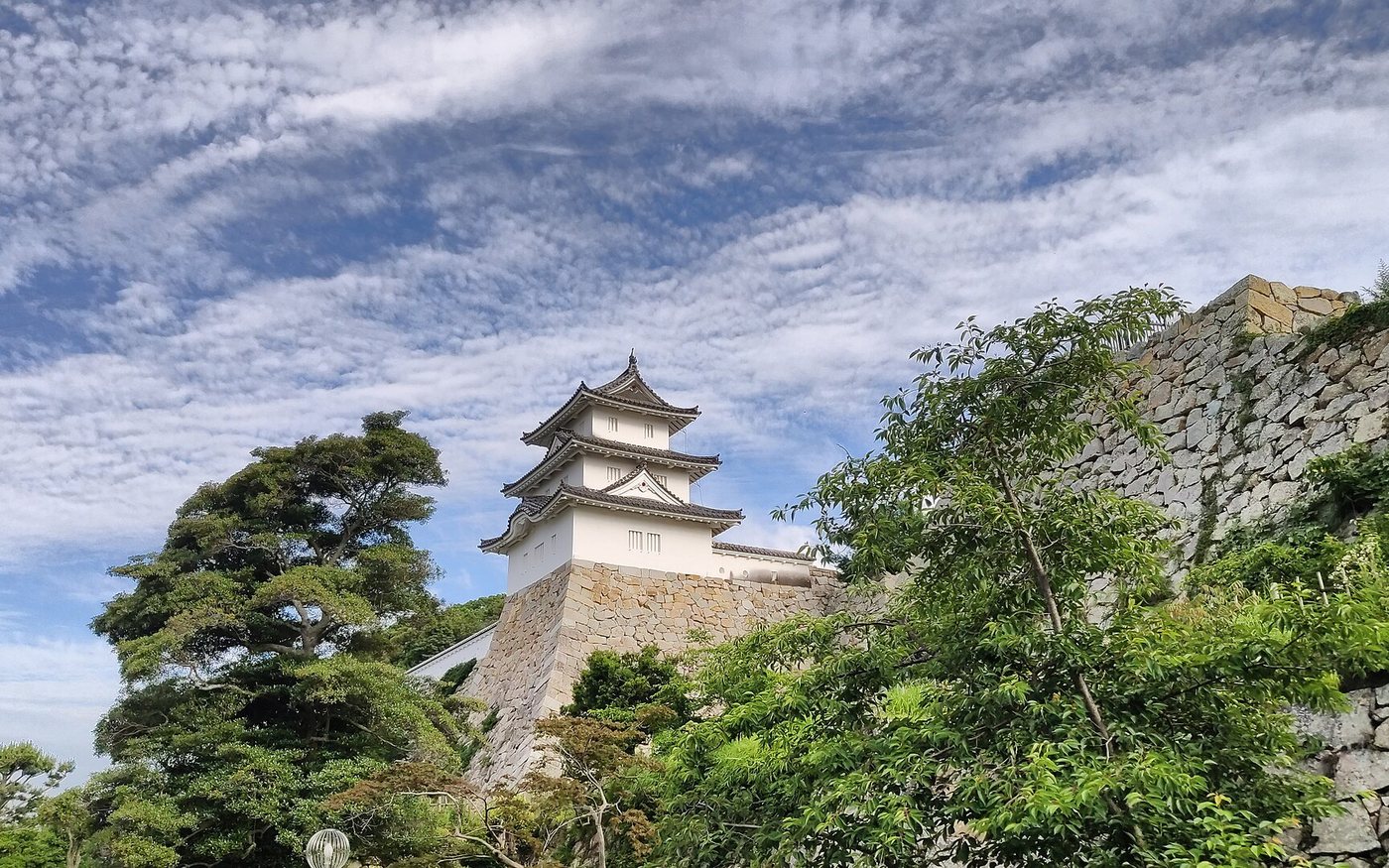
Akashi is forty minutes west of Osaka on the express through Kobe. The tower Japan sets its clocks from, a castle whose keep was never built, and the street where the local egg dish became a trade all sit within two kilometres of one station.
- Base
- JR Akashi, north exitThe park is five minutes on foot, the fish street three, the planetarium fifteen east.
- Length
- One day09:30 to 16:30 for the town; add two hours if you cross to Awaji.
- Tickets and crossing
- ¥2,100Planetarium ¥700 and the ferry return ¥1,400. The market and the park cost nothing to walk.
- Book ahead
- NothingThe planetarium issues numbered tickets from 09:30; the ferry takes you at the pier.
1What Akashi has that Kobe does not
The 135th meridian that Japan sets its clocks from runs through the town, the castle has two original turrets and no keep, and the fish street is 350 metres of arcade with about 110 shops.
The special rapid from Osaka station takes about 40 minutes. Tokyo to Nishi-Akashi is 3 hours 27 minutes on a Hikari, Hakata about 2 hours 30, Okayama 40 minutes, Kansai airport 1 hour 30, Itami 1 hour.
Three stations, and they are not interchangeable. JR Akashi and Sanyo Akashi share a crossing five minutes from the park gate. Hitomarumae, one stop along the Sanyo line, is three minutes from the planetarium. The Shinkansen stops at Nishi-Akashi, five minutes further by JR.

Source: Wikimedia Commons · もんじゃ, CC BY-SA 4.0
2The order the day works in
Two things set the sequence, and neither is distance. The planetarium stops admitting people at 16:30 and shuts on Mondays. The fish street has no collective closing time; every shop sets its own. So the market goes first, while it is surely open, the tower second, because the 09:30 ticket decides the afternoon, and the park third, because it never closes.
13:00 is the plain answer for the show. On a weekday the first general show is 11:30, with 10:00 kept for booked school groups. At a weekend, 14:30.
Then walk west to the park for the turrets and the garden, and end at the harbour, where the bridge and Awaji sit on the horizon. The ferry is the last move.

Source: Wikimedia Commons · Kzaral, CC BY 2.0
3Uontana: 350 metres, 110 shops
The arcade starts three minutes from JR Akashi and runs about 350 metres, with roughly 110 shops under the roof. It is a working fish street rather than a sight. The counters sell that morning's catch, octopus, nori and ikanago, the sand eel that turns up in spring. Dried octopus and sweet-simmered ikanago travel better, and several shops post what you buy.
Do not plan around a closing time. Hours differ by shop, so the safe window is the middle of the day. A few counters serve tamagoyaki at a stool.
Uontana shopping street 魚の棚商店街
- Address
- Uontana office, 1-1-16 Honmachi, Akashi 673-0892 · Map
- Phone
- +81 78-911-9666
- Hours
- Covered arcade, no gate; each shop keeps its own hours
- Closed
- Each shop sets its own closing day

Source: Wikimedia Commons · m-louis, CC BY-SA 2.0
Keep reading Osaka transport 2026: a pass for one line, cash on the other
4Tamagoyaki: the egg dish the city calls by another name
The city counts about 70 shops selling it. Locals call it tamagoyaki, and the curtain outside says so; akashiyaki is the name the town uses on visitors. The batter is egg, wheat flour and jinko, a starch left over from making fu. Jinko does not harden when it cooks, which is why the middle stays soft.
It is cooked in a copper pan, not the cast-iron takoyaki pan, and the copper is what lets the batter puff instead of setting. A pan holds ten, fifteen or twenty depending on the shop. It arrives with dashi to dip, not sauce.
The old house on Kajiya-cho publishes its prices. One order is 20 pieces for ¥1,300, and two people may share it. Its oden runs ¥500 for octopus, ¥300 for sinew and ¥200 for the rest.
Honke Kimuraya 本家きむらや
- Address
- 5-23 Kajiya-cho, Akashi 673-0884 · Map
- Phone
- +81 78-911-8320
- Hours
- 10:00–16:30, and it closes when the day's batch runs out
- Closed
- Monday, and one Tuesday a month

Source: Wikimedia Commons · Midori, CC BY-SA 3.0
5The planetarium on the 135th meridian
It opened on 10 June 1960 directly above the meridian. The projector is a Carl Zeiss Jena UPP23/3, installed for the opening and still running. The dome is 20 metres with 300 seats, and the operator says it has run more days than any other planetarium in Japan since 2012. The tower is 54 metres, with the observation room on floors 13 and 14.
Admission is ¥700 for an adult and covers the planetarium, the exhibition rooms and the observation room. High school age and under are free, residents over 65 are free, visitors over 65 from outside the city pay ¥350, and an annual pass is ¥2,000. Opening is 09:30 to 17:00, last entry 16:30; the car park is ¥200 for two hours then ¥100 an hour.
Five shows a day, about 45 minutes each, ticketed by number rather than by seat, and the numbers go out from the desk at 09:30. Weekdays run 11:30, 13:00, 14:30 and 16:00, with 10:00 only for a booked school group. Weekends and holidays run 10:00 for children, 11:30, 13:00 for children, 14:30 and 16:00.
The meridian history is in the same building. The first marker went up in 1910, the city fixed the true line by astronomical observation in 1928, and a dragonfly-shaped marker followed on Hitomaruyama in 1930. With a phone, the GPS line sits about 120 metres off the stone, which the operator calls the gap between astronomical and map surveying, not an error.

Source: Wikimedia Commons · m-louis, CC BY-SA 2.0

Source: Wikimedia Commons · どがさん, CC0
6Akashi Castle: two turrets and no keep
The second Tokugawa shogun, Hidetada, ordered the castle in 1618 as a check on the west; its first lord was Ogasawara Tadamasa. The park puts the budget at 1,000 kan of silver, about 3.1 billion yen at today's money. The keep that never went up is the point of the place. Two corner turrets survive, Tatsumi and Hitsujisaru, both Important Cultural Properties, and they are two of the twelve three-storey turrets left in Japan.
Tatsumi came from Funage castle when the one-castle-per-province rule took that one down, burned in 1631 and was rebuilt; the 1982 overhaul gave it standard timbers. Hitsujisaru is the largest building the castle ever had, and stands in for the keep. Records say it came from Fushimi, and the 1982 survey found it built elsewhere first.
The 1631 fire started in the outer bailey's kitchen and took the inner bailey, which had gold leaf walls. What is left is stonework, water and 54.8 hectares, which the operator measures as thirteen Koshien stadiums. A robot dressed as a samurai strikes the hour drum every two hours, and the observatory looks over the strait to the bridge and Awaji.
Akashi Park and Akashi Castle 明石公園・明石城
- Address
- 1-27 Akashi-koen, Akashi 673-0847 · Map
- Phone
- +81 78-912-7600
- Hours
- Open to walk at any hour
- Closed
- None, and there is no admission charge
- Website
- hyogo-akashipark.jp

Source: Wikimedia Commons · KishujiRapid, CC BY-SA 4.0

Source: Wikimedia Commons · KENPEI, CC BY-SA 3.0

Source: Wikimedia Commons · KENPEI, CC BY-SA 3.0
7Thirteen minutes to Awaji
The ferry leaves the harbour south of the fish street and reaches Iwaya port on Awaji in about thirteen minutes. An adult one way is ¥700, a child ¥350, a passenger with a disability certificate ¥350, a bicycle ¥300 and a motorcycle up to 125cc ¥630. The bicycle charge applies even to a folded bike.
Weekdays run 05:40 to 23:40 out of Akashi, every twenty to forty minutes. Weekends and holidays, on the winter table from 1 November to 31 March, start at 06:30 and still end at 23:40.
Iwaya is a port with a bus stop and little else. The ferry buys the crossing, not a second itinerary.
Awaji Jenova Line, Akashi pier 淡路ジェノバライン 明石乗り場
- Address
- 2-10-1 Honmachi, Akashi 673-0892 · Map
- Phone
- +81 78-918-2411
- Hours
- Weekdays 05:40–23:40 from Akashi; weekends and holidays 06:30–23:40
- Closed
- Runs daily; the boat is switched for weather and the crossing takes about 13 minutes

Source: Wikimedia Commons · 松岡明芳, CC BY-SA 3.0
8When everything shuts
Monday shuts the planetarium, not the market, the park or the ferry. The other fixed line is 16:30, the last entry rather than the last show. Nothing else has a gate, so the ferry is the only timetable that strands you. The last boat from Iwaya is 23:20 and the last one out of Akashi is 23:40.
9Where to sleep
Akashi is not a town to build a trip around. Most people sleep in Kobe or Osaka and come out on the express. Based in Kobe, this is a natural second day beside the Kobe day, and the chains in the Kansai APA guide cover the night. Klook Kobe Trip.com Kobe Klook Osaka Trip.com Osaka
10Questions and answers
What to settle before the day, including the weekday that undoes it.
Is Akashi worth a day of its own, or is it a stop on the way to Himeji?
A day. The planetarium on the 135th meridian, a castle with two surviving turrets and no keep, a fish street 350 metres long with about 110 shops and a ferry to Awaji in thirteen minutes all sit within two kilometres of one station, and none of it needs a car or a booking.
How long does the day take?
About seven hours for the market, the planetarium and the park, from 09:30 to 16:30. Add two hours if you cross to Awaji and back.
Can I do this on a Monday?
Not the planetarium. It closes on Mondays, the second Tuesday of the month and over the year end, and opens instead when a closure day falls on a public holiday, closing the day after. The market, the park and the ferry run as usual, so a Monday becomes a market and castle day.
What is the difference between akashiyaki and takoyaki?
The batter and the pan. Akashiyaki is egg and flour with jinko, a wheat starch that stops it firming as it cooks, so the middle stays soft. It is cooked in a copper pan rather than the cast-iron takoyaki pan, and it comes with dashi to dip it in, not a brush of sauce. The city marks the origin story disputed.
Can I take a suitcase or a bicycle to Awaji?
A bicycle costs ¥300 each way, bagged or not. Luggage goes as a parcel by weight.
| For the day | Why it matters | Check |
|---|---|---|
| Planetarium show ticket | Numbered, issued from the desk when the doors open at 09:30; the ticket decides which show you get | — |
| Awaji ferry, return | Bought at the pier; the bicycle charge applies even to a folded bike | — |
| IC card for the trains | The JR and Sanyo lines in and out of Akashi take one card | Klook |
| Lunch on the arcade | Shop hours are the one thing here with no published answer | — |
Keep reading


Sources
- Akashi City, access: the special rapid from Osaka about 40 minutes, Hikari from Tokyo to Nishi-Akashi 3 hours 27 minutes, Hakata about 2 hours 30, Okayama about 40 minutes, Kansai airport about 1 hour 30, Itami about 1 hour (city.akashi.lg.jp).
- Akashi Park, the north exit of JR and Sanyo Akashi five minutes on foot, and Nishi-Akashi to Akashi five minutes by JR (hyogo-akashipark.jp).
- Akashi Municipal Planetarium, opening hours 09:30–17:00 with last entry 16:30, the Monday, second-Tuesday and year-end closures and their holiday rule, ¥700 adult admission covering planetarium, exhibition rooms and observation room, free for high school age and under, ¥350 for visitors over 65 from outside the city, ¥2,000 annual pass, the car park tariff, and the numbered-ticket rule from 09:30 (am12.jp).
- Akashi Municipal Planetarium, the 10 June 1960 opening, the Carl Zeiss Jena UPP23/3 projector, the 20-metre dome and 300 seats, the operating-days record since 2012, the 54-metre tower, the five daily show times, the 1910, 1928 and 1930 meridian markers, Time Day, and the 120-metre difference between the markers and a GPS reading (am12.jp).
- Akashi City, on akashiyaki: about 70 shops in the city, the jinko in the batter, the copper pan, the local name tamagoyaki, the late-Edo account with its note that the origins are disputed, and the 1919 stall in Taruya-cho (city.akashi.lg.jp).
- Akashi City, on the local fisheries: octopus, nori and ikanago as the catch this coast is known for (city.akashi.lg.jp).
- Honke Kimuraya, ¥1,300 for one order of 20 with two people allowed to share it, the oden prices, 10:00–16:30 with the batch running out, closed Monday and one Tuesday a month, and the Kajiya-cho address (honke-kimuraya.com).
- Akashi Park, the 1618 order and Ogasawara Tadamasa, 1,000 kan of silver and the operator's 3.1 billion yen conversion, the two turrets and the twelve surviving three-storey turrets, the Funage and Fushimi moves, the 1631 fire, 54.8 hectares, the 1883 and 1918 openings, and the 2004 garden restoration (hyogo-akashipark.jp).
- Hyogo Tourism, the Uontana arcade at about 350 metres and about 110 shops, the office address and phone, shop-by-shop hours, the drum robot every two hours, and the observatory's view of the bridge, Awaji and Ieshima (hyogo-tourism.jp).
- Awaji Jenova Line, the crossing about 13 minutes, ¥700 adult one way, ¥350 child, ¥350 disability fare, ¥300 bicycle including one in a bag, ¥630 for a motorcycle up to 125cc, the weekday 05:40–23:40 and winter weekend 06:30–23:40 timetables, and both pier addresses (jenova-line.co.jp).
- Every fare, hour and closure in this guide is current as of 15 November 2026. The planetarium's show times changed in summer 2026, and the ferry fare has stood since 1 January 2025.