
The Seishun 18 Kippu is not a pass and never touches a Shinkansen. It comes in two versions, three consecutive days for ¥10,000 and five for ¥12,050, and the winter sale opened on 27 November 2026. What it covers, the five stretches where JR bends its own rule, and the arithmetic behind the two prices.
- Three days
- ¥10,000
- Five days
- ¥12,050
- Winter travel
- 11 Dec to 11 Jan
- Sale opened
- 27 Nov 2026
1What five days of local trains buys
One flat fare covers the slow network. On any JR line from Hokkaido to Kyushu it covers ordinary and rapid trains in ordinary-car non-reserved seats, with unlimited stop-offs. No age limit, no residency requirement and no child version: a six-year-old pays the same ¥10,000 or ¥12,050.
Three BRT bus routes that replaced lost railway lines also qualify: the Kesennuma line between Yanaizu and Kesennuma, the Ofunato line between Kesennuma and Mori, and the Hita-Hikosan line run by JR Kyushu Bus between Soeda and Hita. The JR West ferry to Miyajima is included; the island's own ¥100 visit tax is not.

Source: Wikimedia Commons · LERK, CC BY-SA 4.0
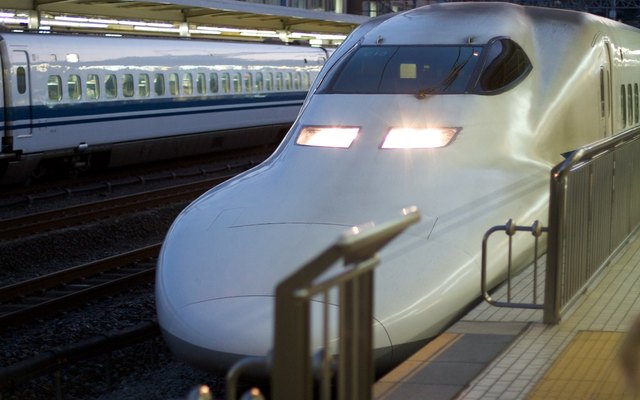
Nor does it buy speed: a five-day ticket costs a quarter of the seven-day Japan Rail Pass's ¥50,000 and moves you far less than a quarter of the distance in the same time, because every train stops at every station.
2The three dates that decide a winter trip
The ticket went on sale on Friday 27 November 2026, and sales close before the travel window does. The three-day version sells until 9 January 2027 and the five-day until 7 January 2027, for start dates inside the window.

Source: Wikimedia Commons
Travel runs 11 December 2026 to 11 January 2027, and because the days must be consecutive from the start date, 8 to 11 January is reachable only on a ticket already running.
Each ticket is sold from one month before the start date, so a 3 January start can be bought from 3 December; the first ten days of the sale are for December travel.
Winter is the shortest of the three windows: spring 2027 runs 1 March to 10 April with sales from 13 February, and summer runs 18 July to 8 September. It also collides with the year-end peak, when unreserved cars are fullest and the ticket guarantees no seat.
3The price, and the number that picks the version
| Ticket | Price | Cost a day | What it covers |
|---|---|---|---|
| Three-day version | ¥10,000 | ¥3,333 | Three consecutive days, one person |
| Five-day version | ¥12,050 | ¥2,410 | Five consecutive days, one person |
| The last two days | ¥2,050 | ¥1,025 | What a five-day ticket adds over a three-day one |
| Child fare | ¥10,000 or ¥12,050 | Same as adult | No child version is sold |
| Hokkaido Shinkansen option | ¥4,650 | One one-way ride | Shin-Aomori to Kikonai, then to Goryokaku |
| Refund fee | ¥220 | Per ticket | Only before the first day is used |
| Japan Rail Pass, 7 days | ¥50,000 | ¥7,143 | Shinkansen and limited express included |

Source: Pexels
Three days at ¥10,000 works out at ¥3,333 a day and five at ¥12,050 comes to ¥2,410. The extra pair costs ¥2,050, or ¥1,025 each, so anyone who can fill five consecutive days should take the five-day version.
Avoid the version bought for one long ride. Tokyo to Kyoto in a day means local trains through Atami, Shizuoka, Hamamatsu and Nagoya, and a through fare costs less. The ticket pays when the days are full, which is why the operators time it to school holidays.
4The 2024 change that catches people out
The ticket was rebuilt for the winter 2024 season, and most advice online still describes the booklet it replaced.

Source: Pexels
The days are consecutive. You name a start date when you buy and the ticket runs from it without gaps. The old booklet stamped five separate days whenever the holder chose, which is why old posts talk about saving one for later. There is nothing to save now.
One ticket, one person. A family of four needs four, two adults cannot share one, and after the first day it cannot be handed to anyone else.
The ticket goes through the automatic gates at JR stations, so staff no longer stamp it each morning. It will not open another company's gate, transfer gates included, so a wrong turn at a through station means paying at the barrier.
The final day runs to the last train of the normal timetable, even on a night when trains run all night, which makes a 23:00 departure on the last day legal.
5What it will not carry

Source: Pakutaso
Shinkansen, limited express and express trains are excluded, along with Green car reserved seats and every sleeper. A Green car non-reserved seat works with a Green ticket on top, a reserved seat needs a seat ticket, a liner train a liner ticket. The ticket pays the basic fare and stops there.
Five stretches are the exception, where no ordinary service runs alongside.
- Ou main line, Shin-Aomori to Aomori: limited express non-reserved seats
- Sekisho line, Shintoku to Shin-Yubari: reserved seats, empty ones only
- Muroran main line, Higashi-Muroran to Muroran: reserved seats, empty ones only
- Sasebo line, Haiki to Sasebo: limited express non-reserved seats
- Miyazaki Airport line, Miyazaki to Miyazaki Airport: limited express non-reserved seats
On the first, fourth and fifth, a ride that continues past the stretch needs the full fare and express charge for the whole ride, so use the exception only inside it.

Source: Wikimedia Commons (CC BY-SA 3.0)
Private and third-sector railways are outside the ticket. The terms name Donan Isaribi, Aoimori, IGR Iwate Galaxy, Sanriku, Hokuetsu Express, Shinano Railway, Echigo Tokimeki, Ainokaze Toyama, IR Ishikawa, Hapi-line Fukui, Ise Railway, Kyoto Tango, Chizu Express, Tosa Kuroshio and Hisatsu Orange, plus any other company's line a JR train runs through onto.

Source: Wikimedia Commons · Suikotei, CC BY-SA 4.0
Four carry a passage exception when you cross them to stay on JR the same day: Aoimori (Aomori to Hachinohe, stops at Aomori, Noheji and Hachinohe), Ainokaze Toyama (Toyama to Kurikara, stops at Toyama and Takaoka), IR Ishikawa (Kurikara to Tsubata, stop at Tsubata) and Hapi-line Fukui (Echizen-Hanando to Tsuruga, stops at both ends). Step off anywhere else and the full fare is due. JR buses are excluded in principle; the three BRT routes above are the exception.
6The Hokkaido Shinkansen option ticket
Crossing to Hokkaido is the one place the group sells an add-on. It costs ¥4,650, one way, once, and is valid only alongside a current Seishun ticket. On its own it buys nothing.

Source: Wikimedia Commons · Goryokaku-Tower, CC BY 4.0
It covers two legs in sequence, the Hokkaido Shinkansen between Shin-Aomori and Kikonai in an ordinary-car non-reserved seat or any empty seat, then the Donan Isaribi Railway between Kikonai and Goryokaku. The gates read the Shinkansen coupon only when the Seishun ticket goes in with it, and the Isaribi coupon is shown to staff.
Two limits decide whether it helps. It starts at Shin-Aomori, so the run from Tokyo is still local trains on the Ou main line, and it ends at Goryokaku, a tram ride from Hakodate's waterfront rather than the station. Stopping off is allowed at Kikonai only. Sales run to 11 January 2027, and refunding the pair costs ¥440.
7Buying it, moving it, refunding it
It is sold at main JR stations including the reserved-seat ticket machines, at Midori-no-madoguchi counters, at JR travel centres and at larger travel agencies. All are inside Japan, and machines that only sell commuter tickets do not carry it.

The start date is fixed at the counter, so have the calendar in hand, and an early or late start needs the ticket bought the day before, because offices keep hours.
One change is allowed. The start date can be moved once, before the period or inside it while the ticket is unused, and the swap cannot cross versions. A second change means a refund and a fresh purchase.
A refund before the start date, or inside the period if the ticket is unused, costs ¥220 per ticket. After the first day there is no refund at all, including when weather stops the trains, and a lost ticket is not replaced.
8Routes where the ticket does the work

Source: Wikimedia Commons (CC BY-SA 4.0)
Izu, from Tokyo. The Tokaido line reaches Atami and the Ito line ends at Ito, where the JR track stops; the Izu Kyuko from Ito to Izukyu-Shimoda is a separate company, so the ticket takes you to the barrier. Shimoda and Kawazu are an add-on, and in late February that add-on is the earliest bloom of the year.
Nikko, from Tokyo. The Utsunomiya and Nikko lines end at JR Nikko, with the shrine a bus or long walk away. Tobu's Nikko station is across the river and its trains are not covered.
West from Kyoto or Osaka. Sanyo line special rapids reach Himeji and Okayama on the ticket, and Himeji's castle is fifteen minutes on foot from the station. The Hapi-line Fukui stretch between Echizen-Hanando and Tsuruga is the one private section the ticket carries you across, which is what makes a Tsuruga connection possible.

Source: Pexels
Kyushu, from Hakata. The Kagoshima main line runs south through Kumamoto to Kagoshima on the ticket, with the Kyushu Shinkansen alongside for anyone in a hurry.
9Questions and answers
The sharing rule, the Shinkansen question, and what a change of plan costs.
Can two people share one Seishun 18 Kippu?
No. One ticket covers one person for its three or five days, and that rule arrived with the 2024 version. Two travellers buy two tickets, a ticket cannot be handed over after the first day, and two children cannot ride on a single ticket either.
Does the Seishun 18 Kippu work on the Shinkansen?
No, on none of them, and not on limited express or express trains either. Five short stretches are the exception, and Hokkaido needs a paid add-on: the ¥4,650 Hokkaido Shinkansen option ticket, bought with a valid Seishun ticket.
Is the Seishun 18 Kippu cheaper than the Japan Rail Pass?
Far cheaper, and slower. Five days on the Seishun ticket cost ¥12,050 against ¥50,000 for the seven-day Rail Pass, and the Rail Pass carries Shinkansen while this one carries local trains.
What happens if my plans change after I buy it?
Move the start date once, free, before the period begins or inside it while the ticket is unused. The three-day and five-day versions cannot be swapped. A refund before the first day costs ¥220 per ticket, and after the first day there is no refund at all, even if a storm stops the trains.
The pass it is usually weighed against: JR Pass 2026, the break-even on the two price lists
Keep reading


Sources
- JR Group, the Seishun 18 Kippu page: the nationwide coverage of ordinary and rapid trains in ordinary-car non-reserved seats, the BRT routes and the JR West Miyajima ferry with the ¥100 Miyajima visit tax collected separately, the age-free eligibility with no child version, the one-ticket-one-person rule, the automatic gate rule and its exclusion of other companies' gates, the third-sector list, the four passage exceptions, the five limited-express exceptions, the last-train rule on the final day, and the bar on combining it with other discount tickets (jr-group.jp/seishun18)
- JR Group, the release of 5 February 2026 on the 2026 seasons and the Hokkaido Shinkansen option ticket: the winter use period of 11 December 2026 to 11 January 2027, the sale runs from 27 November 2026 to 9 January 2027 for the three-day version and to 7 January 2027 for the five-day, the one-month sales rule, the spring and summer windows, the start-date change once, the ¥220 refund fee, the ¥4,650 option ticket with its two coupons covering Shin-Aomori to Kikonai and Kikonai to Goryokaku, its ¥440 refund, and the lost-ticket rule (jr-central.co.jp, press release 000044897)
- JR East, the five-day product page: the sale points at main stations, reserved-seat ticket machines, Midori-no-madoguchi counters, JR EAST Travel Service Centres and major travel agencies, the one-month advance sale, and the seat-type table showing every Shinkansen, limited express and Green car column refused (jreast.co.jp/tickets, GoodsCd 3001)
- JR Group, the same release, for the per-day arithmetic: ¥10,000 over three days and ¥12,050 over five, with the ¥2,050 difference between the two tickets worked out here rather than quoted. Fares, rules and dates above are current as of 27 November 2026.