
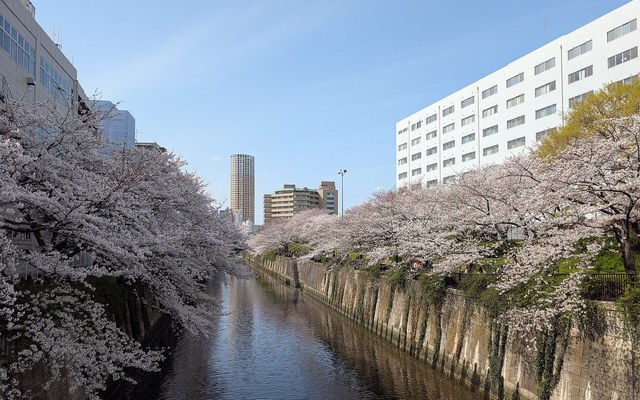
The Meguro River is not a park. It is a narrow channel with a walkway on each side, and the crowds come for about 800 trees on the Meguro side and another 700 on the Shinagawa side. The mistake visitors make is treating it as one place reached from one station. It is three walks, and the lanterns are on for three hours a night.
- Lanterns, 2026
- 17:00–20:00
- Walk, end to end
- 3.8 km
- Trees
- ~800 + ~700
- Entry
- Free, no ticket
1Three pieces, three stations
The river runs through three wards and the useful part runs downhill from Setagaya into Shinagawa. The ward's own cherry map divides the walk into stretches that start at different stations, and the split is the reason two people can both say they saw the Meguro River and describe different trips.
| Stretch | Station and lines | What it is |
|---|---|---|
| Upper | Ikejiri-Ohashi, Tokyu Den-en-toshi | The quiet end. Trees on both banks, few stalls, walkable at 09:00. |
| Middle | Nakameguro, Tokyu Toyoko and Tokyo Metro Hibiya | The famous photograph, and the bottleneck. Stalls, lanterns, police tape. |
| Lower | Meguro, JR Yamanote, Namboku, Mita, Tokyu Meguro | The widest water and the emptiest bank, down Gonnosuke slope from the station. |

Source: Wikimedia Commons (CC0)
Ikejiri-Ohashi is the one to use if you have already seen the postcard. The ward names it as one of the four stations with access to the river, alongside Daikanyama, Meguro and Fudomae, and 大橋 is where the map's distance chain begins. The bank above it is a residential street, and on a weekday morning you can walk a kilometre there and pass a dozen people.
Nakameguro is where the crowd is, and it is genuinely a different event. The station has two operators and one narrow footbridge's worth of exits, the lanterns start at the water's edge, and the walkway is the footway of a street where people live. Staff route the flow one way and ask you not to stop. Come here for the atmosphere and expect to move at the speed of the person in front.

Source: Wikimedia Commons (CC BY-SA 3.0)
The Meguro end is the one people skip and the one that behaves most like a riverside walk. Down the slope from the station the water is wider, the path is on both banks with railings, and the trees continue toward Gotanda. It is also the end where you can arrive at 18:00 and still find a spot at the railing.
2The 20:00 line
The lights are a lantern festival with a fixed end, and the end is what you plan around. The association's cherry map prints one window for the whole of the Meguro bank, 17:00 to 20:00 in late March and early April, and adds the sentence that decides the date, that the period moves with the bloom. The district's own bridge-side light-up on 南部橋–皀樹橋 runs from 27 March to 5 April 2026, and it is dark at the same hour.

Source: Wikimedia Commons (CC BY-SA 4.0)
The ward publishes eight numbered requests for the season, and two of them are rules rather than advice. Hanami after the lanterns and the light-up go out, 20:00 onwards, is not wanted, so the bank is not a place to sit at night. Sheets and parties are banned outright, and the reason sits in the same document, that this is a quiet residential street.
The rest of the list is the sort of thing you would guess and other people ignore. Take your rubbish back to the shop that sold it, keep your voice down, keep walking, smoke only in the marked places, and stay out of the water and the planted beds. Photographers cause most of the friction here, because a branch over the water is always one step into somebody's garden.

Source: Wikimedia Commons (CC BY-SA 4.0)
Downstream, Shinagawa runs its own event on the same water and it is not on the same clock. The Gotanda Fureai waterside plaza is lit from 19 March to 12 April in 2026, 17:00 to 21:00, with a colour sequence three times a night. If you have missed the 20:00 cut at Nakameguro, that is where the evening continues, one stop down.
3Festival days are not peak bloom days
Two calendars run in parallel here and only one of them is about flowers. The Nakameguro festival and the East Area festival both fall on the same weekend, 28 and 29 March in 2026, 10:00 to 17:00, at the playground by the river confluence and at Tadamichi Hiroba park. The shopping streets fix that weekend in January, months before anybody knows when the trees will open.

Source: Wikimedia Commons (CC0)
The trees answer to the weather agency's sample tree in Tokyo, and that record is the only dated fact in the whole season. In 2026 it opened on 19 March, five days before the 1991–2020 average of 24 March, and reached full bloom on 28 March, three days before the average of 31 March. The festival weekend landed on full bloom by luck, and the luck is the point. Move either number by a week and the same weekend is bare branches or falling petals.
So build the trip the other way round. Pick the fortnight from the averages and the forecast, then decide whether you want the festival in it. The full city-by-city picture for the season, and what the averages are worth before January, sits in the 2027 cherry blossom dates. If your Tokyo days are already fixed, the three-day and five-day itineraries are where to move a morning.
One thing the festival weekend does buy you is food. Stalls and kitchens gather at the two parks and along the middle stretch, and the ward's map lists them for the two days. It costs you the walk, because the same weekend is the one where the walkway stops being walkable.
4The walk
The association prints walking distances on its map, and added up they give the number everyone quotes. 大橋 to the middle stretch is about 1.6 km, the middle to Meguro Shinbashi about 1.7 km, and Meguro Shinbashi up to Meguro station 0.5 km. That is 3.8 km, and it is the walk rather than the river, which is longer and runs out to Tokyo Bay.

Source: Wikimedia Commons (CC0)
| Time | Where | Why then |
|---|---|---|
| 08:55 | 大橋, where the map's distance chain starts | The trees begin here and the bank is still somebody's morning walk |
| 09:00–09:35 | 1.6 km to 中目黒駅付近 | The empty hour, and the only leg you can walk at your own pace |
| 09:10 | 千歳橋 to 日の出橋, ❹ to ❻ on the map | The one-way stretch, arrows on each bank, 中目黒駅方面 and 池尻大橋駅方面 |
| 09:35 | 中の橋, ❷ on the map's bridge list | A natural place to stop, and the last bridge on the quiet half |
| 09:50–10:35 | 1.7 km to 目黒新橋 | The middle stretch behind you, the bank thinning out |
| 10:40 | 目黒新橋 | Wider water and the Shinagawa stretch ahead |
| 10:50 | Meguro station, up Gonnosuke slope | 0.5 km on the map, and the Yamanote platform at the top |

Source: Wikimedia Commons (CC BY 4.0)
Two hours covers it at a stroll with photographs. The bridges with something to see from them are on the ward's numbered list, ❷中の橋 above all, because that is where the bank is closest to the water and the trees meet overhead. Anything you have read about a red bridge, or a bridge the blossom falls off, is a caption rather than a facility, and the official map does not name one.

Source: Wikimedia Commons (CC0)
Come back after 17:00 on a different day rather than doing both halves in one. The lantern hour is a queue, and the morning is the walk. The same channel in winter is a light installation, which is a separate trip with a separate set of dates, and the Tokyo side of it is in the winter illumination list.
5What is not decided yet
Three things about 2027 do not exist yet, and each one has a place to check it.
- The dates. The ward's 2027 cherry map was not published in November 2026 and the 2026 edition is the current one. The lantern window follows the bloom, so the dates cannot be set before the forecast.
- The festival. Both shopping-street festivals announce in January for a weekend in late March. Watch the Nakameguro association's page rather than a listings site, which republishes last year's dates with a new year on them.
- The forecast. The first 2027 cherry forecasts land in January. Until then the only dated numbers are the 1991–2020 averages and the 2026 observations above.
The cruise is the one bookable thing on the water, and it runs on its own calendar from the pier at Tennozu. The 2026 rates were on the map: ¥5,000–6,000 on the day, ¥4,000–5,000 in advance. Budget for the walk and let the boat be the option.
6Questions and answers
The dates that exist, the hour the lights stop, and which of the three stations to use.
When is the Meguro River sakura in 2027?
Nobody has published a 2027 date. The river has no ticket and no opening day, so the only dates that exist are the lantern period, which the ward sets when the trees open, and the two festival weekends, which the shopping streets fix in January. In 2026 the lanterns ran from late March into early April, 17:00 to 20:00. Read the 2026 dates as the shape of the season, not as next year's calendar.
What time do the lights go out?
20:00. The ward asks visitors to go home when the lanterns and the light-up switch off, so the river is dark and empty after that.
Which station should I use?
Ikejiri-Ohashi on the Tokyu Den-en-toshi line for the quiet upper stretch, Nakameguro on the Tokyu Toyoko and Tokyo Metro Hibiya lines for the middle and the crowds, and Meguro on the JR Yamanote plus three more lines for the downstream end. They sit on three different lines, and the ward's own distance chain puts the walk between the first and the last at 3.8 km.
Can I sit under the trees?
No. Laying a sheet or holding a party on the bank is banned, because the path is the pavement of a residential street.
Is the festival weekend the best day to go?
It is the busiest and it is not always the pinkest. The shopping streets book their stalls for a fixed weekend and the trees arrive when the weather says, so in some years the party lands before the flowers open. If you want blossom rather than stalls, watch the weather agency's Tokyo observation and go on a weekday morning, on the bank upstream of the middle station.
| For the Meguro River trip | Why it belongs on this page | Check |
|---|---|---|
| Nakameguro and Daikanyama rooms | Inside the walk, and the weekend the pavement stops being walkable | Klook Trip.com KKday |
| Gotanda and Meguro rooms | The downstream end, where the 20:00 cut does not apply | Klook Trip.com KKday |
| Tokyo day trip | For a Tokyo stay that would rather not plan three stations | Klook KKday |
| Japan eSIM | The forecast and the ward's map are both read on the day | Klook Trip.com Airalo |
The rest of the year: Japan by season, and what each window decides
Keep reading


Sources
- Meguro Tourism and Town Development Association (一般社団法人めぐろ観光まちづくり協会), 2026 Meguro River and Meguro greenway cherry manner map. The lantern period, late March to early April at 17:00–20:00, carries the note that it moves with the bloom, and it is printed for two stretches of bank, 池尻大橋駅付近–中里橋 and 中里橋–品川区境 (meguro-kanko.com/sakuramap, 2026 PDF)
- The same map, its 2026 events and practical pages. The festival dates of 28–29 March at 10:00–17:00 with both venues, the site office from 20 March to 5 April, the eight numbered manner requests, the numbered bridge list from ❶氷川橋 to ❾中里橋, the walking distances of 1.6, 1.7 and 0.5 km, the one-way arrows marked at 千歳橋–日の出橋 between 池尻大橋駅方面 and 中目黒駅方面, and the cruise rates from the pier at Tennozu (meguro-kanko.com)
- Meguro City, the ward's own cherry-season requests for spring 2026: the eight numbered requests, including the line that hanami after the lanterns and light-up go out, 20:00 onwards, is not welcome, and that sheets and parties are banned (meguro-kanko.com, city.meguro.tokyo.jp 区報 15 March 2026 issue, page 16)
- Shinagawa Tourist Association, the Gotanda waterside light-up 2026: 19 March to 12 April, 17:00–21:00, the colour sequence at 18:00, 19:00 and 20:00, the five-minute walk from Gotanda and eight from Osaki, and the 23 March start of the stall village (shinagawa-kanko.or.jp)
- Japan Meteorological Agency, cherry blossom observations: the Tokyo sample tree opened on 19 March 2026, five days before the 1991–2020 average of 24 March, and reached full bloom on 28 March, three days before the average of 31 March (data.jma.go.jp/sakura)
- Nakameguro station-front shopping association, the 40th Nakameguro sakura festival: the festival date published in January, the venue at the confluence playground, and the lantern run of fifteen days from the Tokyo bloom announcement (nakamegu.com)
- JR East Media, access from Meguro station: the walk down Gonnosuke slope to 目黒新橋, and the split of the trees between the Meguro side and the Shinagawa side of the river (media.jreast.co.jp)
- Every date here is current as of 21 November 2026. The 2027 map and the first 2027 forecast are published in the weeks before the season.