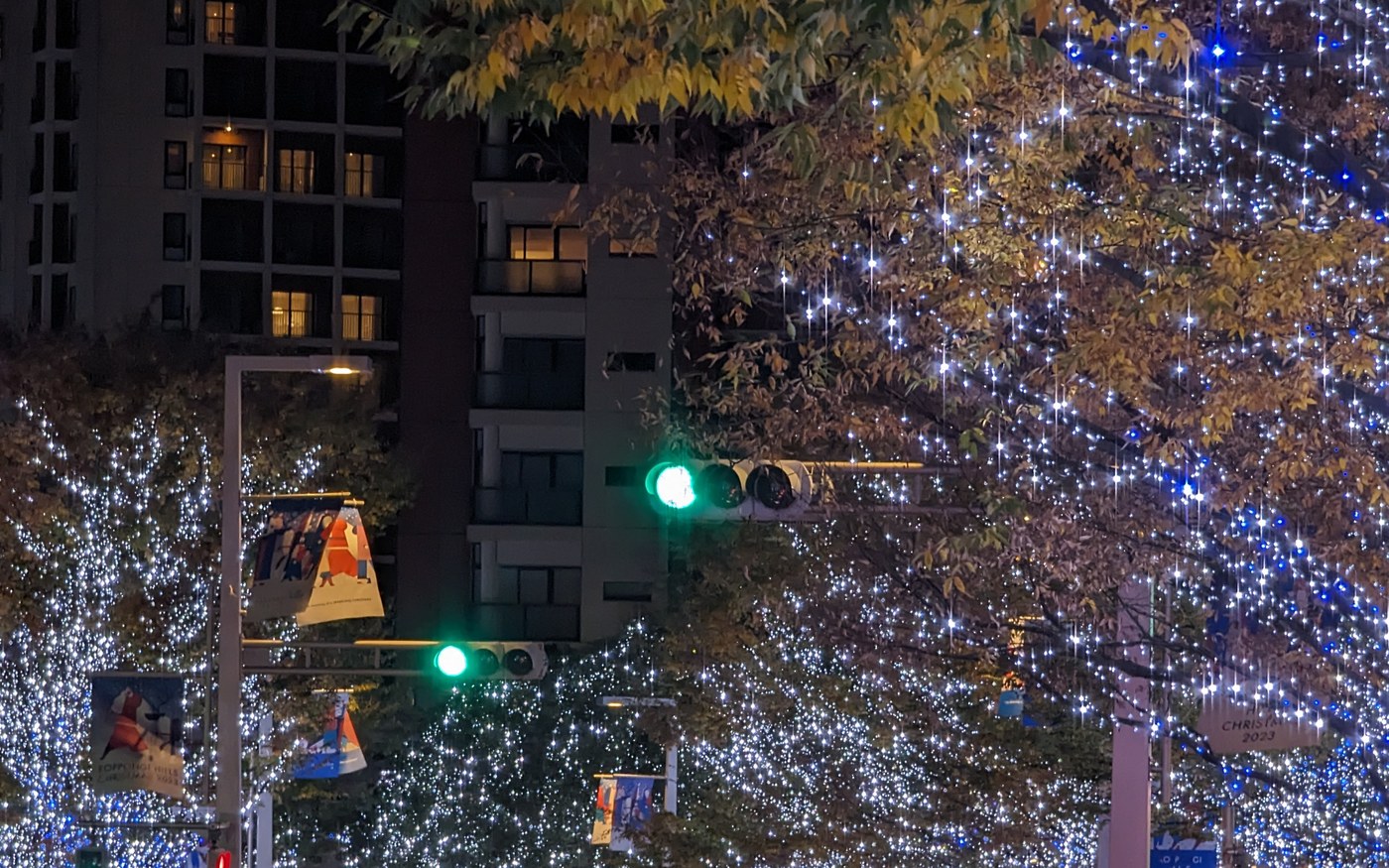
Source: Wikimedia Commons · Syced, CC0
Winter lighting runs in Japan from late October to February, and it is one of the few things in Tokyo that is free, outdoors and genuinely worth the walk. Twenty-three events have published their 2026-27 dates. The two changes that matter this season: the Tokyo Christmas Market moved one of its venues, and the Yokohama Red Brick Warehouse market started charging an entry fee that it never charged before.
1The whole season on one table
The dates below come from the operator that runs each event — the building owner, the railway company, the park, the market committee — and not from a listing site. Where an operator has not yet published a daily time, the table says so rather than guessing: several publish their detail in late October, so a handful of rows will fill in over the next fortnight.
| Event | 2026-27 dates | Lights on | Cost | Nearest station |
|---|---|---|---|---|
| Roppongi Hills — Keyakizaka | 5 Nov – 25 Dec | 17:00–22:00 | Free | Roppongi, Hibiya Line exit 1c, 3 min |
| Roppongi Hills — 66 Plaza | 13 Nov – 27 Dec | 17:00–24:00 | Free | Roppongi |
| Tokyo Midtown Christmas | 26 Nov – 25 Dec | 17:00–23:00 | Free | Roppongi, Oedo Line exit 8, direct |
| Tokyo Dome City — Snow Dome City | 19 Nov – 28 Feb | 17:00–24:00 | Free | Suidobashi or Korakuen, 1 min |
| Marunouchi Illumination (25th edition) | 12 Nov – 14 Feb | Not yet published | Free | Tokyo Station, Marunouchi south exit |
| Marunouchi Bright Holiday (Harry Potter) | 12 Nov – 25 Dec | Not yet published | Free | Tokyo Station, 1 min |
| Hibiya Magic Time Illumination | 12 Nov – 28 Feb | 16:00–23:00 | Free | Hibiya or Yurakucho |
| Shibuya Blue Cave | 11 – 27 Dec (planned) | Not yet published | Free | Shibuya, Koen-dori side |
| Omotesando Illumination | 1 – 25 Dec (planned) | From sunset to 22:00 (planned) | Free | Omotesando or Meiji-jingumae |
| Meguro River Minna no Illumination | 4 Dec – 31 Jan (provisional) | Not yet published | Free | Osaki or Gotanda, 6 min |
| Azabudai Hills Christmas Market | 21 Nov – 25 Dec | 11:00–21:00 | Free to enter | Kamiyacho, exit 5, direct |
| Tokyo Christmas Market — Shin-Toyosu | 20 Nov – 25 Dec | 11:00–21:30 | ¥1,000–2,000 adult | Shin-Toyosu, 2 min |
| Tokyo Christmas Market — Shiba Park | 4 – 25 Dec | 11:00–22:00 | ¥1,000–2,000 adult | Onarimon, exit A6, 1 min |
| Roppongi Hills Christmas Market | 21 Nov – 25 Dec | 11:00–21:00 | Free to enter | Roppongi |
| Yokohama Red Brick Warehouse market | 20 Nov – 25 Dec | 11:00–22:00 (varies by week) | ¥500–1,000 entry | Bashamichi, 6 min |
| Ballpark Xmas Yokohama Kannai | 20 Nov – 25 Dec | Day and after dark | Free | Nihon-odori |
| Art Rink, Yokohama Red Brick Warehouse | 28 Nov – 14 Feb | 13:00–21:00 (front half) | ¥2,000 adult, skates included | Bashamichi, 6 min |
| YORUNOYO, Yokohama waterfront | 4 – 30 Dec | 17:00–21:05 | Free | Nihon-odori or Motomachi-Chukagai |
| Yomiuriland Jewel Illumination | 29 Oct – 4 Apr | 16:00–20:30 | ¥1,800 gate, ¥1,600 online | Keio-Yomiuriland, then the gondola |
| Sagamiko Illumillion | 14 Nov – 9 May | 16:00–21:00 | From ¥2,000 adult | JR Sagamiko, then a bus, 8 min |
| Ashikaga Flower Park — Flower Fantasy | 17 Oct – 14 Feb | 15:30–20:30, weekends to 21:00 | ¥1,500 adult, ¥800 child | JR Ashikaga Flower Park, 3 min |
| Ibaraki Flower Park — Moonlight Rose Garden | 10 Oct – 24 Jan | 17:00–20:30 | ¥1,500, then ¥1,200 adult | JR Ishioka, then a bus, 30 min |
| Tokyo Mega Illumination, Oi Racecourse | 31 Oct – 10 Jan, race days excepted | 16:30–21:00 | Priced by date | Oi-keibajo-mae, 2 min |
| Enoshima — Shonan no Hoseki | 1 Dec – 28 Feb | 17:00–20:00, weekends to 21:00 | ¥500 garden + ¥800 tower after 17:00 | Katase-Enoshima, 20 min |
Three things to read out of that table before you plan anything.
Most of it ends on Christmas Day. The illuminations tied to Christmas — Roppongi, Midtown, Omotesando, the markets — switch off on 25 December, and 25 December is a Friday this year, so the last weekend is the 19th and 20th. If you are in Tokyo in January, you are looking at the second half of the table: Marunouchi until 14 February, Hibiya and Tokyo Dome City until 28 February, the two flower parks and Yomiuriland well into spring.
Free does not mean small. The four biggest free displays in the city are the Keyakizaka row at Roppongi Hills, the 1.2 km of champagne-gold trees along Marunouchi Naka-dori, the million-plus white LEDs across Tokyo Dome City, and the Midtown garden. The paid ones are paid because they are parks with a gate, not because they are better.
17:00 is the switch-on hour, not the arrival hour. Almost every display lights between 16:00 and 17:00 and stays on until between 20:30 and midnight. Arriving at 16:30 in December gets you a queue at the coffee stand and a grey sky; arriving at 17:30 gets you the lights and, on a weekday, room to stand.
2Central Tokyo: what is free, and when it lights
Source: Wikimedia Commons · Syced, CC0
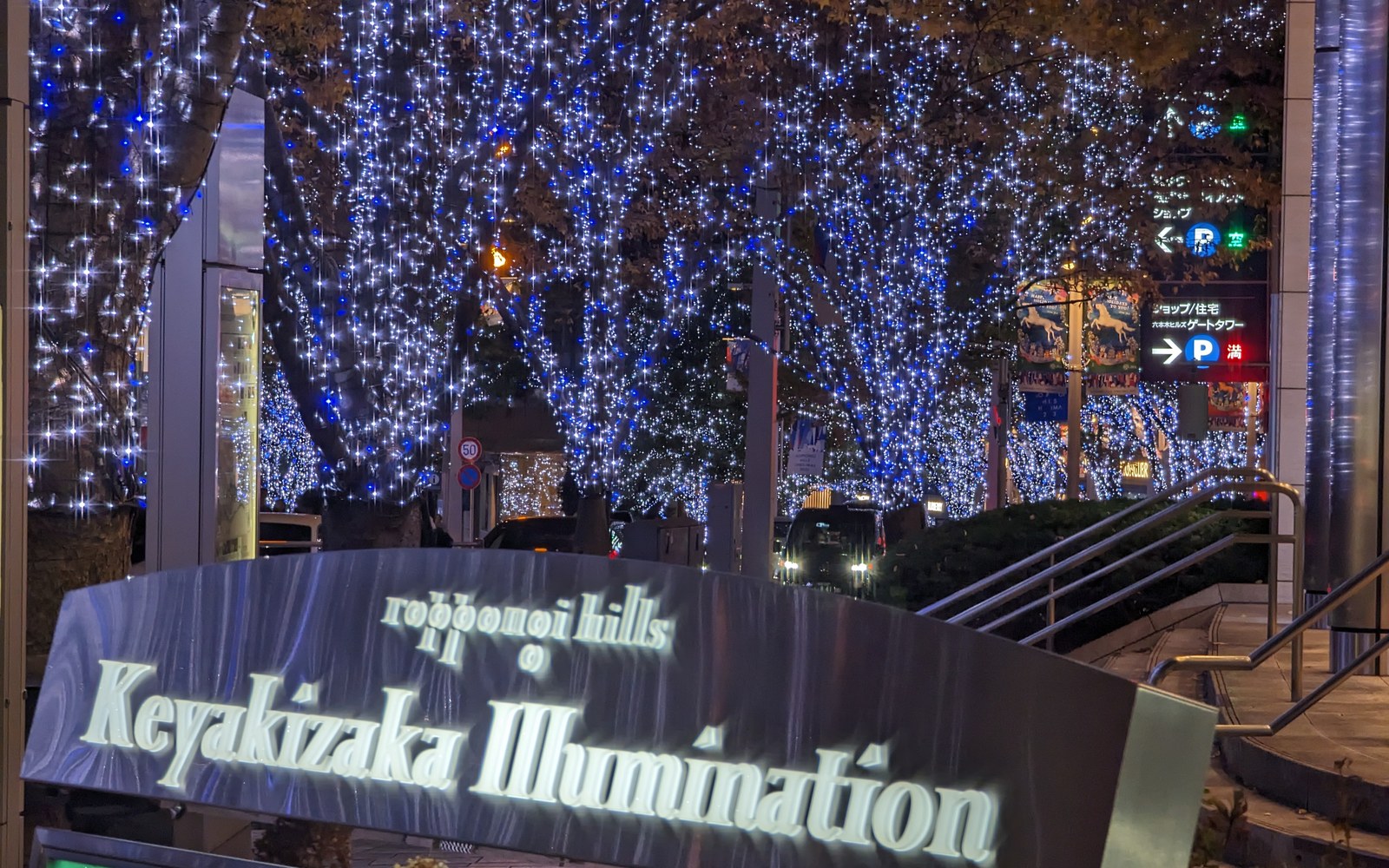
Roppongi Hills. The Keyakizaka illumination is the one to build an evening around: 400 metres of zelkova wrapped in about 970,000 white and blue LEDs, 17:00 to 22:00, 5 November to 25 December, free, and three minutes from Roppongi Station's exit 1c. Walk down the slope, not up it, so Tokyo Tower is in front of you. The same complex runs two smaller displays — 66 Plaza in champagne gold, on until midnight from 13 November, and Mouri Garden, lit in a different palette, until 23:00 — plus a Christmas market on the Ooyane Plaza from 21 November and a Tiffany-sponsored tree in West Walk.
Tokyo Midtown. A 10-minute walk from the Roppongi Hills slope, and the better show for children. The garden lights 17:00 to 23:00 from 26 November with soap bubbles drifting through the beams every four minutes until 20 December, an 8.5-metre real fir tree as the centrepiece, and a gold “path of light” of about 340,000 bulbs that stays up until 23 February. New this year is a raised lounge inside the lights, which you get into by buying food or drink. The outdoor ice rink opens on 5 December.
Source: Wikimedia Commons · Dick Thomas Johnson, CC BY 2.0
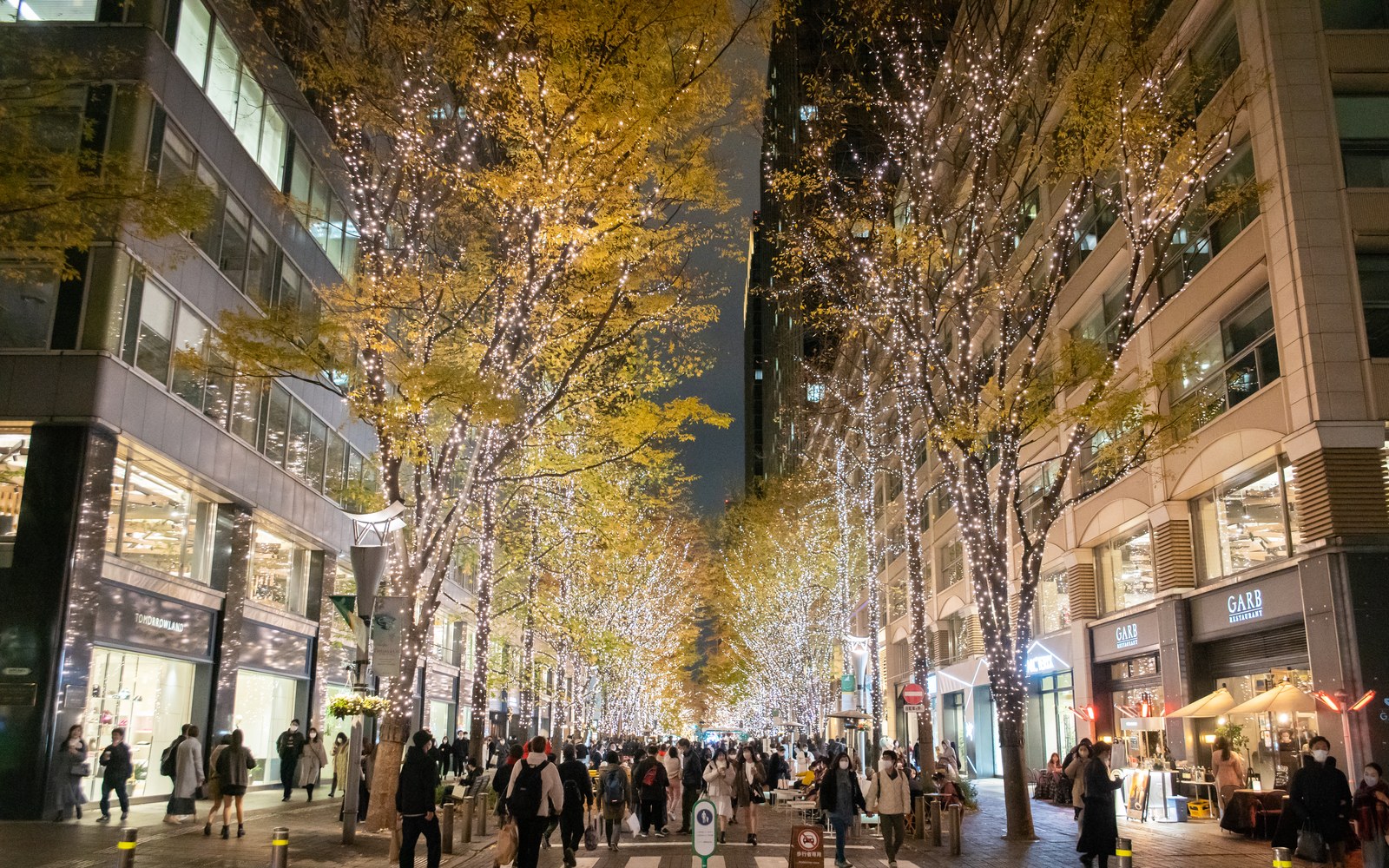
Marunouchi. The 25th edition of the Naka-dori illumination runs 12 November to 14 February — the longest run in central Tokyo — and dresses 1.2 km of street trees between Tokyo Station and Otemachi in champagne gold. It comes out of Tokyo Station's Marunouchi south exit, so it is the one display you can see on the way to your hotel without planning. The operator has not published this season's daily times; last season it lit at 16:00 and went to 23:00, and to midnight during December. The same programme runs a Harry Potter theme from 12 November to 25 December, with a light-and-music tree in the Marunouchi Building's Marucube atrium, and publishes the rest of its detail in late October.
Hibiya. The step plaza in front of Tokyo Midtown Hibiya holds an eight-metre full-colour tree from 12 November to 25 December, this year themed on the new Avengers film. Across the road, Hibiya Naka-dori, the grand staircase and the sixth-floor garden stay lit from 16:00 to 23:00 until 28 February. Free, and two minutes from Hibiya Station.
Tokyo Dome City. If you want the number that impresses people, it is here: more than a million white LEDs across the whole complex from 19 November to 28 February, 17:00 to midnight, free, one minute from Suidobashi. A 15-metre LED tree runs a five-minute show every hour, and there is a 3.9-metre snow dome you can ring a bell inside. This season's collaboration is Cinnamoroll, which makes it the pick if you are travelling with small children.
3Shibuya, Omotesando and the river walks
The Blue Cave returns from 11 to 27 December, lighting the 900 metres from Shibuya's Koen-dori up to the Yoyogi Park zelkova avenue in blue. It has been free every year and the times have not been published yet; last season it ran 17:00 to 22:00. It is the shortest run in this guide — 17 days — so if you are in Tokyo for a week in December, check the dates against your trip before you promise anyone the blue tunnel. The city's arts festival programme marks the dates as planned rather than final.
Omotesando lights from 1 to 25 December, again flagged as planned: about 150 zelkova trees over 1.1 km carrying roughly 900,000 champagne-gold bulbs between the Jingumae and Omotesando crossings. Its Jingumae end is a short walk from the Yoyogi Park end of the Blue Cave, which is why the two belong in the same evening.
The Meguro River is the odd one out and worth knowing about: roughly 390,000 pink LEDs along 2.2 km of both banks, from 4 December to 31 January, run on biodiesel made from used cooking oil collected from the neighbourhood. The organisers have not published the 2026-27 dates on their own site yet; the December-to-January span comes from the city arts festival listing, so treat it as provisional. The main square is six minutes from Osaki or Gotanda.
Two to skip or recheck. Yebisu Garden Place, whose Baccarat chandelier has been the Ebisu fixture since the 2000s, has not announced its new season — last year's version ran 8 November to 12 January, so an announcement is due. And Odaiba's district-wide display is listed as “mid-November to late December” with no fixed dates or times, which is too loose to plan around.
4The markets, and the new entry fees
Source: Wikimedia Commons · Dick Thomas Johnson, CC BY 2.0
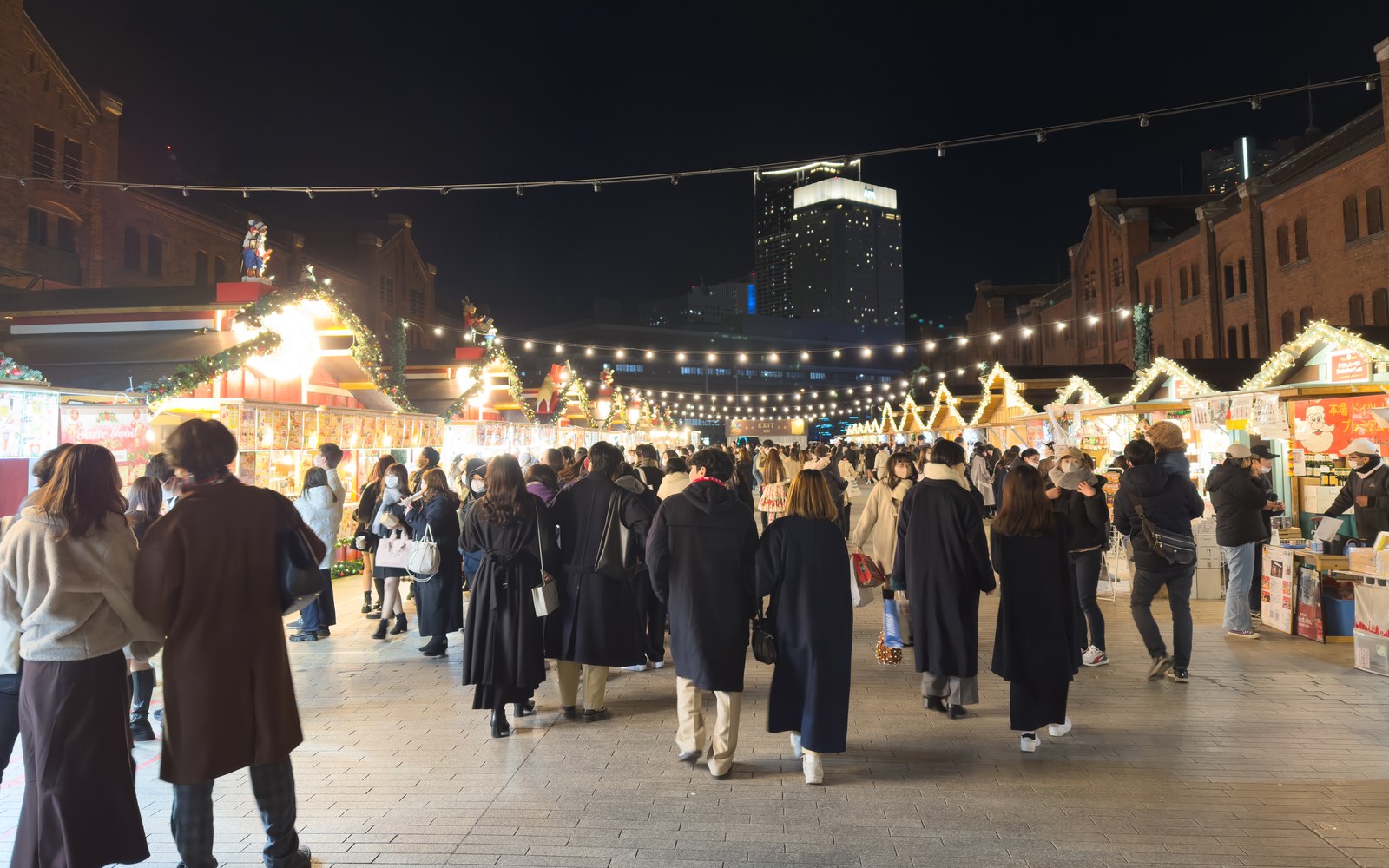
Japan's Christmas markets are copies of the German originals — wooden huts, glühwein, sausages, stollen, an ornament stall that sells nothing else — and two of the three big ones now cost money to walk into.
Tokyo Christmas Market has moved. It runs two venues this year and neither is Meiji Jingu Gaien: a new one at Shin-Toyosu on the bay from 20 November to 25 December, and its long-standing Shiba Park site, with Tokyo Tower behind it, from 4 December to 25 December. Both put a 14-metre Christmas pyramid in the middle. Entry is a dated ticket: ¥1,000 on a weekday and ¥1,500 at the weekend for an adult, ¥2,000 on 24 and 25 December, ¥500 to ¥1,000 for a primary-school child, free under school age. Book ahead and the adult ticket comes with the year's mug — deep blue at Shin-Toyosu, a red at Shiba Park, and the two are designed to stack together. Tickets went on sale on 1 October.
Yokohama's Red Brick Warehouse market is the one that changed: entry is now ¥500 to ¥1,000 by date and ticket type, where last year it was free. Priority entry is ¥2,000 to ¥2,500, and a priority ticket with the premium mug is ¥4,500 to ¥5,000. Primary-school children and under go free, middle-school and under are free until 4 December, and some areas of the site stay free. It runs 20 November to 25 December with a real 11-metre spruce, about 20,000 LEDs on it and a lit roof spanning roughly 30 metres. Two practical notes: same-day tickets at the gate are cash only, and Yokohama residents get in free on 25 November, the city's thanks day.
Azabudai Hills is the counterweight. Its central plaza market runs 21 November to 25 December, 11:00 to 21:00, free to enter, with 19 stalls — four selling goods, fifteen selling food and drink — and it is directly on Kamiyacho Station's exit 5. If you want the market experience without a ticket, this is the one.
Two smaller ones are worth the detour if you are already in the area: the Roppongi Hills market on the Ooyane Plaza (21 November to 25 December, 11:00–21:00, free, and now in its 20th year) and Ballpark Xmas, a 36-day market at Yokohama Park that is free to enter.
5The parks: day trips that need planning
Everything above is walkable from a station in central Tokyo. The next group is not: these are parks and hillsides with gates, ticket prices and, in two cases, a bus at the end. They are also the best lighting in the country.
Ashikaga Flower Park in Tochigi is the one that wins the awards — counted among the country's three great illuminations — and it is the only event here that feels like a garden rather than a street. The season runs 17 October to 14 February, the night session starts at 15:30 and runs to 20:30, or 21:00 at weekends and 21:30 from early November to early January; the lights come on around 17:00. Night admission is ¥1,500 for an adult and ¥800 for a child, day and night are separate tickets, and the park closes only on 31 December. It is three minutes on foot from the JR Ryomo Line's Ashikaga Flower Park station, which is its own stop, and the operator warns that the station is badly crowded when the park closes — so leave before the end, and top up your IC card before you arrive, because the queue for the ticket machine is the real bottleneck.
Sagamiko Illumillion in Kanagawa is the family version, built into a hillside so you look down on the lights, and it goes on far longer than anything in Tokyo: 14 November to 9 May, 16:00 to 21:00, last entry half an hour before closing. Entry varies with the season — ¥2,000 to ¥2,400 for an adult, ¥1,300 to ¥1,700 for a child or a senior — and a night pass bought from 14:00 that adds the rides is ¥3,000 to ¥3,400. From JR Sagamiko station it is an eight-minute bus. Rides inside the lights (a lit tunnel slide, a bicycle ride on a wire above the valley, a rainbow chairlift) are the reason to take the night pass rather than the plain ticket.
Tokyo Mega Illumination at Oi Racecourse is the one to see this year and never again: the venue is being rebuilt and the event goes on hiatus from next season. It runs 31 October to 10 January, but only on days when there is no horse racing — 53 nights in total — so check the calendar before you go, and note that it is shut from 26 December to 1 January. Lights 16:30 to 21:00, last entry 20:00, two minutes from the Oi-keibajo-mae monorail station. Tickets are priced by date, advance dated tickets are cheaper than the gate, and when it is busy the gate stops selling altogether, so buy first.
Ibaraki Flower Park runs a two-part show from 10 October to 24 January on a hillside an hour and a half from Tokyo: roses and marigolds in the first half, then a winter hill of light, a lit rose tunnel and mobiles turning in the wind. Lights 17:00 to 20:30, last entry 20:00. Admission is ¥1,500 for an adult in the first part and ¥1,200 in the second, ¥500 or ¥400 for a child. It closes on Tuesdays, and the last leg is a 30-minute loop bus from JR Ishioka.
Enoshima is the cheapest of the day trips because most of it is free: from 1 December to 28 February the island is lit from the bridge to the shrines, including a wide dome of light around the Sea Candle, and there is a display inside the sea caves. The island's shrines, bridges and palm avenue cost nothing; the Samuel Cocking Garden charges ¥500 (¥250 for a child) after 17:00 and the Sea Candle tower ¥800 (¥400). It is about 20 minutes on foot from Katase-Enoshima, and the lights go off around 20:00, or 21:00 at weekends and in late December. Those are last season's hours; the operator had not published this season's when this went up.
6Yokohama, and the one that runs late
Yokohama is worth a separate evening in December, and YORUNOYO is why. From 4 to 30 December, 17:00 to 21:05, the waterfront from the Osanbashi passenger terminal to Yamashita Park runs a five-minute city-wide show on the half hour, nine times a night, with the waterfront synchronised and a whale projected over the roof of the Osanbashi terminal. It is free, it is the largest event of its kind in the country, and it is the reason to book a Yokohama hotel for one night rather than day-tripping.
The Red Brick Warehouse's own light display, Yokohama Miraito — about 250,000 LEDs along the 1.5 km from Yokohama Station's east exit to Grand Mall Park — has not announced its 2026-27 dates yet. Last year it ran from 6 November to 8 February, 16:00 to 23:00, free, so expect it to fill in shortly.
If you go for the market, note that the art rink at the same site opens on 28 November and runs to 14 February, with a different rhythm from the market: ¥2,000 for an adult including skate hire in the first half, ¥1,700 in the second, ¥1,200 for anyone from three years old to high school, ¥300 to watch. It closes on 13 January.
7What is not coming back, and what is still unannounced
Caretta Shiodome is finished. The blue-light canyon in the Shiodome shopping centre's basement plaza ended with its 2019-20 edition and has not returned; the venue has run no illumination since. Guides that still list it are working from ten-year-old material.
Not yet announced, as of 13 October 2026: Tokyo Skytree Town's Dream Christmas (last year 6 November to 25 December), Tokyo Tower's Winter Fantasy (last year 17 November to 25 December), the Baccarat chandelier at Yebisu Garden Place, Yokohama Miraito, the Yamate Western-style houses' Christmas display, the Cosmo Clock 21 wheel's Christmas lighting, and Tokyo Joypolis. Most of these announce in the last week of October, so this page is worth a second look in November.
8What I would do
One weekday evening in central Tokyo, free. Roppongi Station at 17:20, up exit 1c, and walk down the Keyakizaka slope while the trees are still the brightest thing on the street. Ten minutes on foot to the Tokyo Midtown garden for the bubbles, then either stay in Roppongi for the market or take the Hibiya Line one stop to Hibiya for the step plaza tree, and finish at Marunouchi on the way back to Tokyo Station. Nothing in that route costs anything, and a Tuesday or Wednesday in early December means you can actually stand still for the photographs.
One evening for Shibuya and Omotesando. Start at the Yoyogi Park end of the Blue Cave at 17:00, walk the blue tunnel down to Shibuya, eat, then come back up Omotesando for the gold trees on the way home. Both are free, both are on the same walk, and both are crowded on weekend nights in December.
One day trip. Ashikaga if you want the best-lit garden in Japan and do not mind a 90-minute train each way; Sagamiko if there are children and you would rather ride a lit slide than look at a rose trellis. Book the dated tickets for either before you leave the hotel — both parks price by date and both sell out on December weekends.
Small things that decide the evening. The lights in the parks switch off before the last train but the ones in the streets do not, so a late dinner and then a walk is fine in central Tokyo and impossible in Ashikaga. December nights in Tokyo are cold enough to want gloves, and the waterfront in Yokohama is colder than the thermometer says. Almost every market stall takes cards, but the Red Brick Warehouse gate does not take cards for same-day tickets. And the first week of November is the trap: the only things lit are the four that start in October — Yomiuriland, Tokyo Mega Illumination, Ashikaga and Ibaraki — while the whole of central Tokyo waits for 5 November.
| For the evening out | Why before you go | Check tickets |
|---|---|---|
| Tokyo Subway Ticket (24 / 48 / 72 h) | Two or three of the free displays a night adds up — four rides a day is the break-even | Klook KKday |
| Japan eSIM | Every market runs on QR tickets and every park wants a dated booking | Airalo eSIMania |
Keep reading


.jpg)
.jpg)
Sources
- Mori Building — Roppongi Hills Christmas 2026: Keyakizaka, 66 Plaza, Mouri Garden and West Walk dates, hours, LED count and photo points (mori.co.jp)
- Tokyo Midtown — Midtown Christmas 2026: garden hours, the 340,000-bulb path of light, lounge and ice rink (tokyo-midtown.com)
- Mitsubishi Estate / Marunouchi — Marunouchi Illumination 2026, 25th edition, and Marunouchi Bright Holiday's Harry Potter programme (marunouchi.com)
- Tokyo Midtown Hibiya — Hibiya Magic Time Illumination 2026: step plaza, Naka-dori, staircase and 6F garden (hibiya.tokyo-midtown.com)
- Tokyo Dome — Tokyo Snow Dome City: 102 days, million-plus white LEDs, tree and snow-dome shows (tokyo-dome.jp, press release)
- Tokyo International Arts and Culture Festival (ARTE TOKYO) — programme listing for the Shibuya Blue Cave, Omotesando Illumination, Meguro River and Odaiba (prtimes.jp, organiser's release)
- Tokyo Christmas Market Committee — Shin-Toyosu and Shiba Park venues: dates, hours, ticket prices and mug designs (organiser's release)
- Azabudai Hills — central plaza Christmas market dates, 19 stalls and hours (mori.co.jp)
- Yokohama Red Brick Warehouse — Christmas Market 2026: dates, phased hours, new entry tickets and cash rule at the gate
- Yokohama Arts Foundation — Art Rink “Ice Coming Together”, 28 November to 14 February (press release)
- THE YOKOHAMA ILLUMINATION / YORUNOYO Committee — YORUNOYO 2026 dates, hours, venues and the half-hourly show (yorunoyo.yokohama)
- Yokohama City — Ballpark Xmas Yokohama Kannai 2026 dates and free admission (welcome.city.yokohama.jp)
- Yomiuriland — Jewel Illumination 2026: 138 days from 29 October, hours, and the park's own ticket prices (press release, yomiuriland.com)
- Sagamiko Resort — Illumillion 2026-2027: season dates, hours and the season's price bands (sagamiko-resort.jp, press release)
- Ashikaga Flower Park — Flower Fantasy 2026-2027: dates, night hours, ¥1,500 adult night admission, 31 December closure and the station crowding warning
- Ibaraki Flower Park — Moonlight Rose Garden 2026: dates, both parts, hours, closure days and admission (flowerpark.or.jp)
- Tokyo City Keiba / Tokyo Mega Illumination — 2026-2027 season dates, 53 nights, final season and dated ticket policy (tokyomegaillumi.jp)
- Enoshima Sea Candle — Shonan no Hoseki 2026-2027: dates, lighting hours and garden and tower admission (enoshima-seacandle.com)