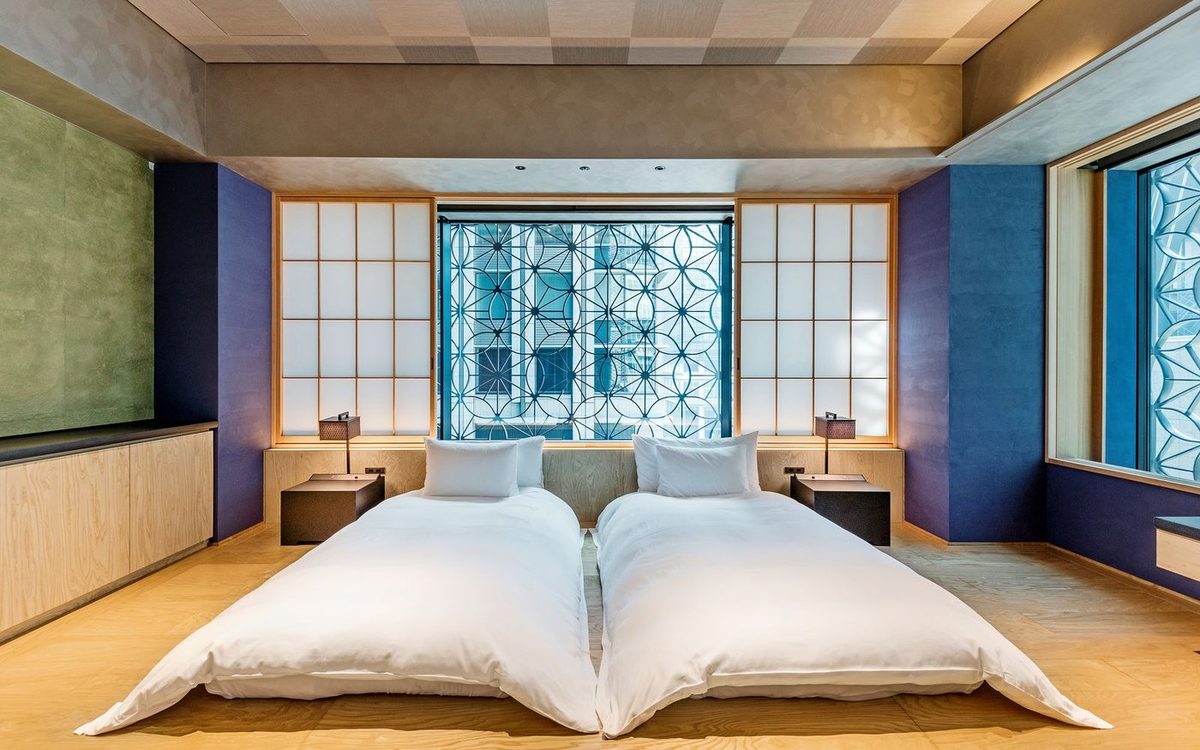
Source: Pexels
A Japanese hotel booking is a contract with numbers in it, and nearly all of it is published before you pay: the rate is per person, the room's capacity counts the baby even when the baby is free, a no-show with no phone call can close the booking at 21:00, and a late check-out is priced by the hour. Here is what each word on the plan buys, what the model contract behind it says, and what the desk adds on the night.
1The price is per person, and the plan is what you bought
Japanese hotels quote a rate per person per night, because the plan is really a package of bed, meals and services for one guest. The screen usually says which it is — 大人2人/1泊の料金 for two guests for one night, 1人あたり per person — but an overseas booking site will often show you a per-room figure for the same room. That difference is how a ¥9,000 room turns into a ¥18,000 night for two, and it is the single most common thing people are surprised by at a Japanese desk.
The plan itself is named after the meals. 素泊まり is room only: no breakfast, no dinner, no restaurant. 朝食付き adds breakfast. 一泊二食 is a night with dinner and breakfast, which is how ryokan sell almost everything. The trap with 素泊まり is geography: the cheap rate on a hot-spring property is cheap because there is nothing else to eat within walking distance, dinner is a fixed sitting, and the hotel's kitchen has already been ordered for the guests who booked the meal plan.
Two details are worth knowing before you compare prices. First, the total on a Japanese page is normally printed twice — 税込 (tax included) and 税別 (tax separate) — and the two numbers differ by 10%. Second, the city accommodation tax that arrives later is assessed on the room-only charge, not on what you paid: Kyoto's own definition of the taxable amount is the room and service charge excluding meals and consumption tax. A plan with dinner in it can therefore sit in a lower tax band than its total suggests.
| On the plan | Read as | What it decides |
|---|---|---|
| 素泊まり | Room only | No meals at all. Check that there is somewhere to eat, and until when. |
| 朝食付き | Breakfast included | Usually a buffet, often ending at 09:30. |
| 一泊二食 | Dinner and breakfast included | Dinner is a set time and usually a set menu. Tell the hotel about allergies when you book, not on the night. |
| 1人あたり · 大人2名 | Per person · two adults | Whether the price you are looking at is for one guest or the room. |
| 税込 / 税別 | Tax in / tax out | A 10% difference between the headline and the real rate. |
| 定員 | Capacity | The most people allowed in that room, children and babies included. |
| 添い寝無料 | Free bed-sharing | Which children are free, and how many per bed. |
| 入湯税 · 宿泊税 | Bathing tax · accommodation tax | Money added at the desk on top of the plan, per person per night. |
| 別途 | Charged separately | Something is not in the price — parking, the onsen, breakfast, a late check-out. |
2The room-type word is a bed width
Japanese hotels are small, so they advertise the bed instead of the room. The word you pick is the width you sleep on, and the range is wider than the English translation suggests: APA, one of the chains on our Tokyo and Osaka lists, publishes 10–11 m² rooms with a 112 cm single or a 142 cm double, and a 22 m² twin with two 122 cm beds.
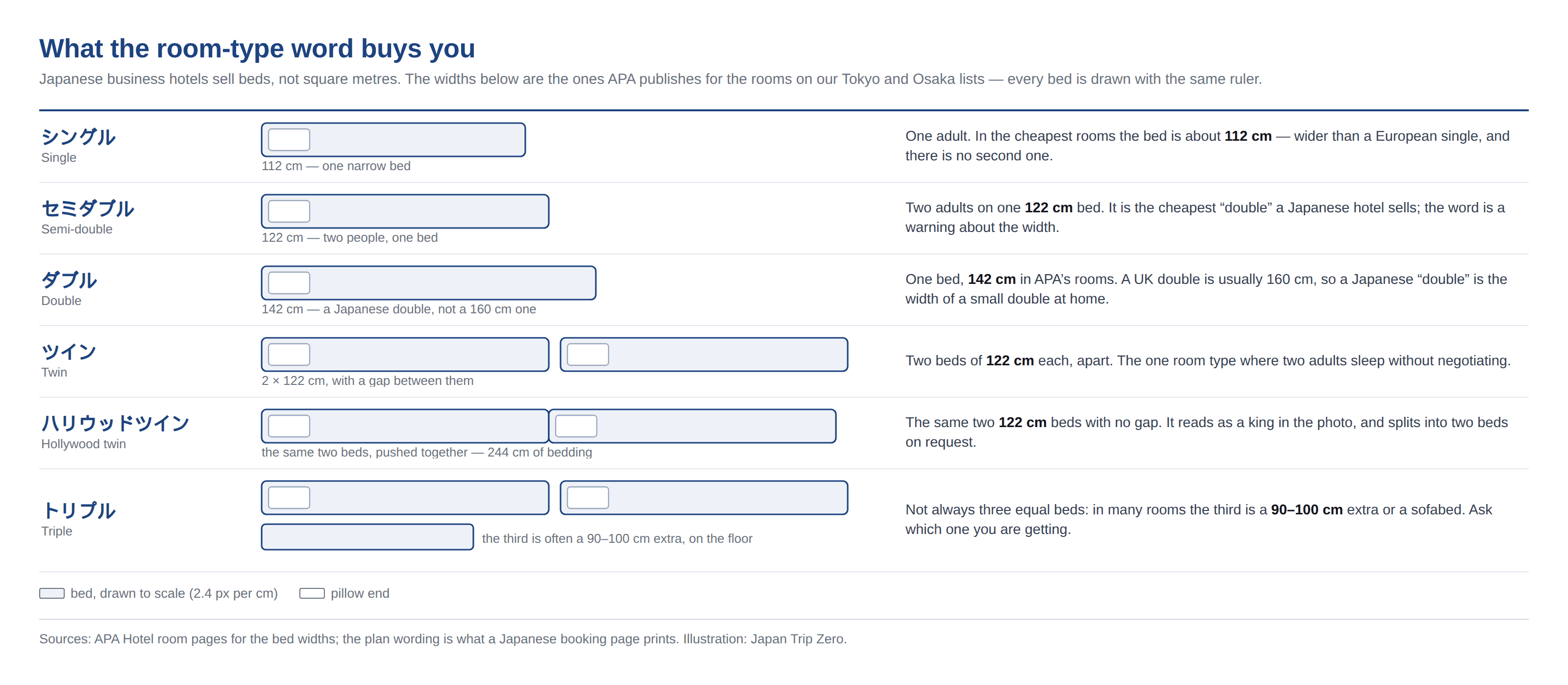
Illustration: Japan Trip Zero
Three of those words are worth remembering. セミダブル sounds like an upgrade on a single and is really one narrow bed sold to two people — 122 cm, which is a large single by any other name. ハリウッドツイン is the same two beds as a twin with the gap removed, so the photograph looks like a king and the housekeeping can split it. And トリプル is not reliably three equal beds: the third is often a 90–100 cm extra, and in some rooms there is no floor space for one at all.
What to do about it: ask for the bed width in centimetres, not the room class, and count the square metres. A 10 m² double in Tokyo is one bed and a narrow strip of floor around it — fine for a night, cramped with two suitcases. If two of you are travelling, a twin is the room that costs the least for the least discomfort, and it is often the same price as the double.
3The capacity counts everyone, including the baby
Every Japanese room has a published 定員 — a maximum number of guests, printed as 最大2名様までご利用可能 or 1室2名様利用. It is not a suggestion and it is not the hotel being difficult: the figure comes from the building's construction and fire standards under the Hotel Business Act, and a hotel cannot trade it away for you at the desk.
The detail that catches families is that a child sleeping free still counts towards the capacity. Super Hotel says so in as many words on its own family page: co-sleeping children are included in the room's capacity, so book the room whose capacity covers everyone you are bringing. Two adults and two toddlers in a two-person room is not a tight squeeze; it is a booking the hotel has to refuse, at the desk, with your luggage in the lobby.
So the arithmetic to do before you search is: adults + every child who is not paying + every infant = the capacity you need. A twin that sleeps two adults free-of-charge for the child is a two-person room in practice: book a triple, or two rooms.
4Children, and when they stop being free
The age at which a child stops being free is different at every chain, and the difference is a school year, not a birthday. APA gives free bed-sharing to children under school age and charges the adult rate from primary school; Toyoko Inn runs its free bed-sharing to the end of primary school. The same ten-year-old is free in one chain and an adult fare in the other, so compare before you pick the hotel.
| Chain | Free co-sleeping | The condition that bites |
|---|---|---|
| APA Hotel | Under school age, one child per bed, one per adult | From primary school the child pays the adult rate, and so does a pre-school child who needs their own bedding or amenities. |
| Toyoko Inn | Primary school age and under, one child per bed | A twin room used by one adult with a small child is charged at the full twin rate. Extra beds do not exist. |
| Super Hotel | Under school age | The child still counts towards the room's capacity. |
| A ryokan on a meal plan | Usually nothing | The model contract's child rates apply to primary school age and under: 70% of the adult rate with adult meals and bedding, 50% with child meals and bedding, 30% for bedding only. |
That last row is the expensive one, and it is why a family holiday in a hot-spring town costs more per head than the same family in a business hotel. A five-year-old is free in a Toyoko Inn room and 50% of the adult rate at the ryokan that feeds them. Both are normal; neither is negotiable at check-in.
5The passport at the desk is the law
If you do not have a Japanese address, the hotel has to record your nationality and passport number in the guest register, ask to see the passport and keep a copy — that is article 4-2 of the enforcement regulations of the Hotel Business Act, and the Ministry of Health, Labour and Welfare publishes the same instruction in English for foreign guests. Four years on, the 2025 revision of the lodging guidelines repeated it and allowed the copy to be kept electronically.
So bring the passport to the desk; a driving licence is not a substitute, and the hotel cannot waive it any more than it can waive the fire rules. If you refuse, the ministry's guidance to hotels is to explain that it is a national requirement, ask again, and treat someone who still refuses as possibly not carrying a passport — which ends with a phone call to the police, not a room. Refusing to give the register details is itself treated as grounds to refuse the stay.
It cuts the other way too. The same Act tells hotels they may refuse a guest in only four situations: an infectious disease, a likelihood of illegal or disorderly behaviour, the guest repeatedly making demands that are unreasonably burdensome to staff — that clause was added on 13 December 2023 — and a full house. Which means an argument you escalate at the desk has a published ceiling, and the calm version usually wins.
6The 21:00 cut-off, and the ladder for a late check-out
Most Japanese hotels base their terms on the tourism agency's model accommodation contract, and two of its clauses are worth knowing by number. The first is the no-show rule: if you have not arrived and have not called by 21:00 — or two hours past the arrival time you wrote down — the hotel may treat the booking as cancelled by you, and charge it. The second is the reverse: once the room is available, the charge stands even if you choose not to use it.
Late check-out is not a favour you ask for at the last minute, it is a price. Under the same contract, overstaying the room's hours costs a third of the room rate for up to three hours, half the rate for three to six, and the full rate beyond that.
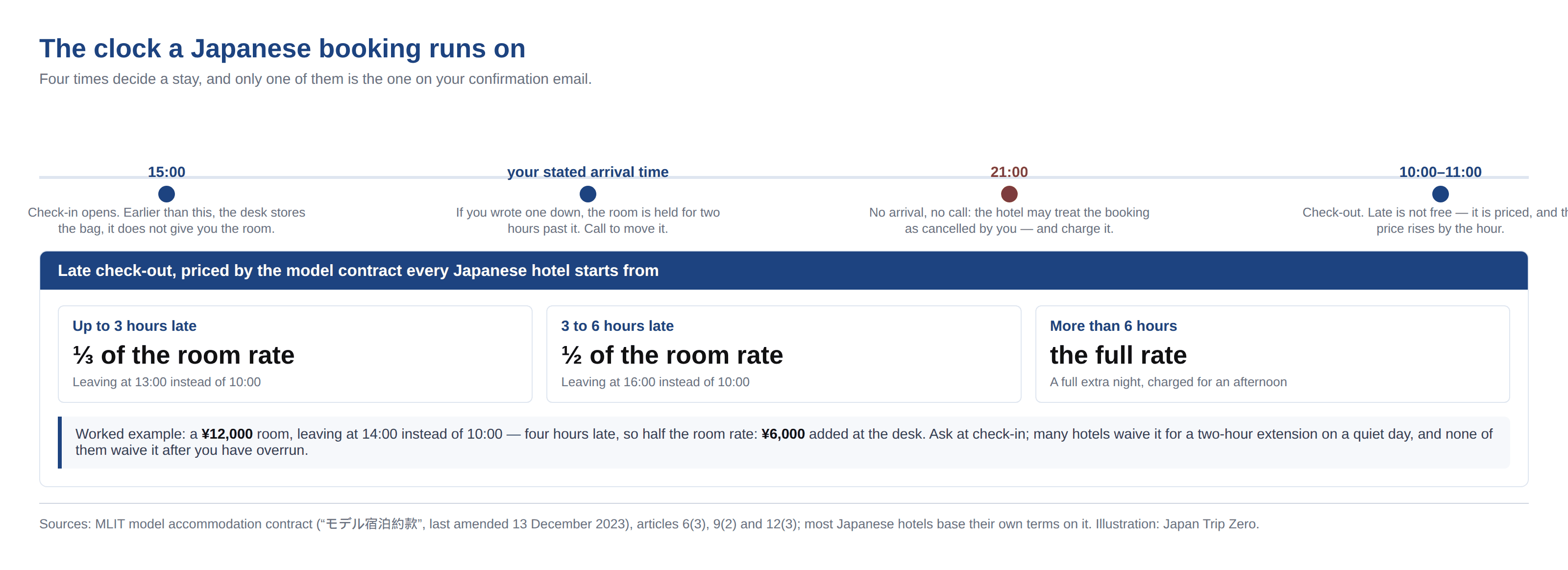
Illustration: Japan Trip Zero
The practical move costs one line before you fly: put your arrival time in the booking, and if the flight slips, email the hotel. A stated arrival time buys you two hours past it, and a call buys you the room. The thing that loses it is the silence — a 23:00 arrival with no message reads to the night desk as a guest who is not coming.
7Cancellation: the table and its deadlines
Every Japanese hotel has a written cancellation table — the model contract leaves the percentages blank and makes each property fill in its own — and you are entitled to see it before you pay. The version we see most often on hotel pages steps like this: free of charge more than a week out, 20% from three to seven days, 50% at two days, 80% the day before, and 100% on the day or for a no-show. A weekly-rate or long-stay plan will have a much longer tail: one chain we looked at starts charging 20% from 89 days before arrival.
Three rules follow from that.
- A prepaid rate is a rate, not a promise of flexibility. The cheaper “no cancellation” plan is the discount you were given for giving up the right to cancel. If your dates could move, the flexible rate is usually worth the 5–10%.
- You cannot cancel a platform booking through the hotel. If you booked on an OTA, the cancellation has to start with the platform, because the platform is holding the reservation the hotel can see. Writing to the hotel produces a polite reply telling you to contact them.
- Never just not turn up. A no-show is the 100% line in every table, and it is also the one thing you cannot argue about afterwards, because the hotel had no chance to resell the room.
Japan's Consumer Contract Act does put a ceiling on all this — a penalty far above the hotel's average loss can be struck down — which is why you rarely see 100% charged weeks in advance. Treat that as a legal argument in a genuine dispute, not as a line to use at the desk on the day.
If you booked direct and need to cancel, email the hotel. Two messages cover almost every case, and the Japanese on the left is the one to copy; the “booking number” is the confirmation number on your email.
| To cancel, in Japanese | What it says |
|---|---|
| 件名:宿泊予約キャンセルの件 | Subject: cancellation of a room booking |
| 「ご担当者様」(予約番号:○○) | To the person in charge (booking number: ○○) |
| ○月○日に宿泊予約を入れている○○と申します。 | I am ○○, booked for ○ (date). |
| 大変申し訳ございませんが、都合によりキャンセルをさせていただきたいです。 | I am sorry, but I have to cancel for personal reasons. |
| キャンセル料をご教えいただけますでしょうか。 | Could you tell me the cancellation charge? |
| キャンセル完了のご連絡をお願いいたします。 | Please confirm once the cancellation is complete. |
Asking about the charge is not naive — it puts the hotel's own number on the record before you both agree to the cancellation, which is the whole point of doing it in writing instead of by phone.
8What the desk adds: two taxes and a receipt
The plan is not the bill. Two taxes sit outside it, both charged per person per night, and both are the local authority's money rather than the hotel's margin.
| Where | Room charge, per person per night | Tax |
|---|---|---|
| Tokyo | Under ¥10,000 / ¥10,000–15,000 / ¥15,000 and over | Nothing / ¥100 / ¥200 |
| Osaka | Under ¥5,000 / ¥5,000–15,000 / ¥15,000–20,000 / ¥20,000 and over | Nothing / ¥200 / ¥400 / ¥500 |
| Kyoto | Under ¥6,000 / ¥6,000–20,000 / ¥20,000–50,000 / ¥50,000–100,000 / ¥100,000 and over | ¥200 / ¥400 / ¥1,000 / ¥4,000 / ¥10,000 |
Two of those tables are new, and one of them is a dated trap. Osaka's bands have applied since 1 September 2025, and Kyoto's since 1 March 2026 — where the charge is decided by the date you stay, not the date you booked. Book a Kyoto trip in 2025 for a stay after that date and prepay the old rate, and the hotel collects the difference at the desk. That is the city's rule, not the hotel inventing a fee. Tokyo changes too, on 1 April 2027, from flat amounts to 3% of the room charge with the exemption threshold lifted to ¥13,000 per person — details in the Tokyo hotel guide.
The other tax is the bathing tax, 入湯税, on the bill of an onsen property: a standard ¥150 per person per day under the Local Tax Act, set by the municipality and often waived for children under 12. You pay it as a guest of the ryokan whether or not you get in the water, and it appears when you settle up rather than in the rate you booked. The model contract lists it next to consumption tax, because that is what it is: a local tax the hotel collects on the town's behalf.
Ask for the right piece of paper, too. A 領収書 (ryōshūsho) is the formal receipt, stamped and made out to a name, and it is what an expense claim or a tax authority wants; a レシート is the till slip. Most front desks will write one while you wait; say 領収書をいただけますか and have the name you want on it ready on your phone.
9When it goes wrong
The most useful clause in the whole model contract is the one about the hotel's own failure. If it cannot give you the room you booked, it has to try to find you an equivalent property with your agreement; if it cannot, it pays you compensation equivalent to the cancellation charge, and that compensation counts towards what you are owed. Being walked to a lesser hotel is the one situation where a Japanese hotel owes you money without a negotiation.
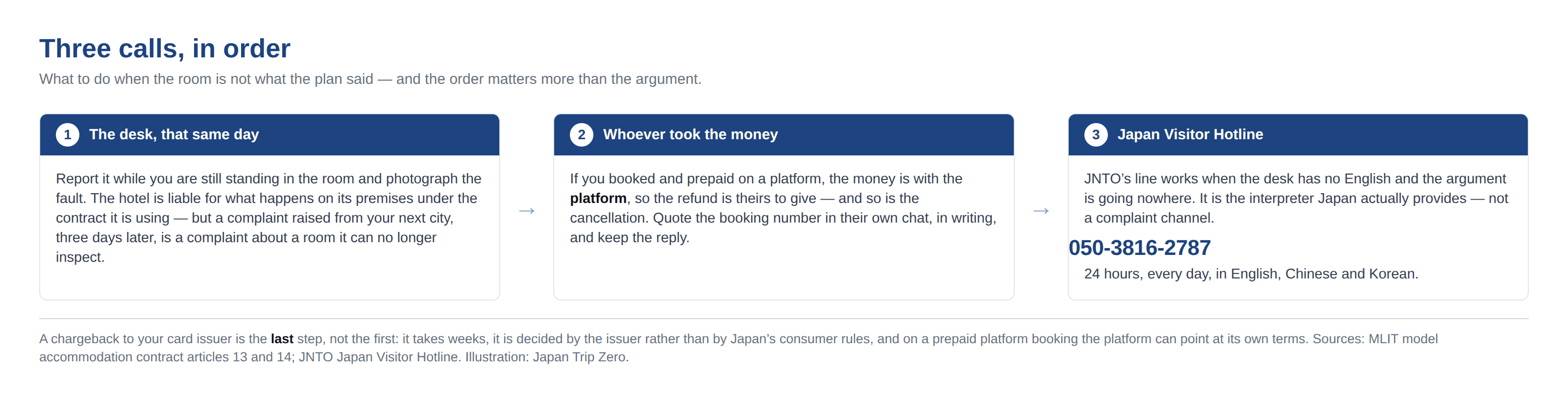
Illustration: Japan Trip Zero
Everything else is about speed. A broken kettle is a two-minute conversation on the night and an accusation three days later; a room that is not the room in the photograph is the same. Report it while you are standing in it. And if something is wrong that the desk cannot fix, the interpreter Japan actually provides is JNTO's Japan Visitor Hotline, 050-3816-2787 — 24 hours, English, Chinese and Korean — which will sit between you and a Japanese-only desk in real time.
The things people leave behind are worth one phone call rather than a shrug: the model contract holds found property for 7 days and then hands it to the local police, so a call the same day usually means the hotel still has it. And valuables are only covered in full if you hand them to the front desk; cash and jewellery left in the room are capped at an amount the hotel fills into the same contract, which is why every Japanese room still has a safe and a written invitation to use it.
10The sentences that fix a problem
Front desks in Japanese cities vary from fluent English to none, and the phrases that carry the most weight are the ones that name a number, a booking or a time. Typed into a phone and shown at the desk, these work.
| Japanese | Reading | English |
|---|---|---|
| 予約番号○○の○○です。 | Yoyaku bangō ○○ no ○○ desu. | Booking number ○○, name ○○. |
| 予定の到着時刻より遅れます。予約を残していただけますか。 | Yotei no tōchaku jikoku yori okuremasu. Yoyaku o nokoshite itadakemasu ka. | I will be later than the arrival time. Can you hold the booking? |
| 予定の部屋と違います。確認していただけますか。 | Yotei no heya to chigaimasu. Kakunin shite itadakemasu ka. | This is not the room I booked. Could you check? |
| エアコンが動きません。見ていただけますか。 | Eakon ga ugokimasen. Mite itadakemasu ka. | The air conditioner is not working. Could you look at it? |
| 子供は何人まで無料ですか。 | Kodomo wa nannin made muryō desu ka. | How many children stay free? |
| チェックアウトの時間を延長できましょうか。 | Chekku-auto no jikan o enchō dekimashō ka. | Can I extend the check-out time? |
| 領収書をいただけますか。 | Ryōshūsho o itadakemasu ka. | May I have a formal receipt? |
11What I would do
- Decide the meal plan before the rate. On a hot-spring property, 素泊まり is a room in a village with one restaurant; if dinner is what you came for, book 一泊二食 and note the sitting time.
- Do the capacity sum including the baby, then book the room type whose 定員 covers it. Free co-sleeping does not add capacity.
- Put the bed width in the search, not the word. A ¥9,000 “double” and a ¥11,000 twin are usually the same room with the beds pushed apart, and the twin sleeps two better.
- Write your arrival time into the booking, and email the hotel if the flight slips past 21:00. That is the whole defence against the no-show rule.
- Screenshot the cancellation table when you book. It is on the plan page, it differs between the flexible and prepaid rates, and it is the only thing that decides what a change of plan costs.
- Budget ¥200–500 per person per night in the big cities and ¥150 in an onsen town, in cash, on top of everything you have already paid.
- Keep the confirmation email until you are home. It is the record of the room class, the number of guests, the meal plan and the arrival time — the four things a dispute is actually about.
| Before you fly | Why it is worth doing early | Check tickets |
|---|---|---|
| Tokyo hotels | The same room swings more than 50% by month; the plan you want sells out first | Klook KKday |
| Osaka hotels | Cherry blossom and autumn weeks are gone months ahead | Klook KKday |
| Luggage storage, Tokyo | Bags before the 15:00 check-in, or after an evening train on the last day | Radical Storage |
| Japan eSIM | The confirmation email, the cancellation table and the hotel's phone number all live on the phone | Airalo eSIMania |
Keep reading
Sources
- Japan Tourism Agency (MLIT) — model accommodation contract (モデル宿泊約款, last amended 13 December 2023): articles 6(3), 9(2), 12(3), 13, 14 and 16(2), and 別表第1 for the child rates and the tax lines.
- Hotel Business Act (旅館業法) — article 5 as amended on 13 December 2023 (the four grounds for refusing a stay), and article 5-2 with enforcement regulation 4-2 on the guest register.
- Ministry of Health, Labour and Welfare — guidance to hotels on foreign guests without a Japanese address (passport presentation and copy, register details), including the 1 April 2025 revision of the lodging sanitation guidelines, and the English notice for foreign guests.
- APA Hotel — room pages for the bed widths and room sizes, and the customer support page for free co-sleeping for children under school age.
- Toyoko Inn — the company's own child page and booking guidance: free bed-sharing to the end of primary school, one child per bed, and the full twin rate for a twin used by one adult with a child.
- Super Hotel — the family-use page: free co-sleeping for children under school age, and that a co-sleeping child counts towards the room's capacity.
- Kyoto City — the lodging tax rates applicable to stays from 1 March 2026, and the FAQ confirming that the tax follows the stay date rather than the booking date (city.kyoto.lg.jp).
- Osaka Prefecture — the accommodation tax bands for stays from 1 September 2025 (pref.osaka.lg.jp).
- Tokyo Metropolitan Government Tax Bureau — accommodation tax bands in force since 1 October 2002 and the change effective 1 April 2027 (tax.metro.tokyo.lg.jp).
- Local Tax Act article 701-2 — the bathing tax and its ¥150 standard rate, as summarised by the Ministry of Internal Affairs and Communications.
- JNTO — the Japan Visitor Hotline: 050-3816-2787, 24 hours, in English, Chinese, Korean and Japanese.
- The hotel and luggage links in the booking table are affiliate links (Klook, KKday, Radical Storage and Airalo, through Travelpayouts and Awin) and cost you nothing extra.