
The maples here peak in the last days of October and the first fortnight of November, before the gardens in Kyoto have started. Most people see the tunnel at midday and take an afternoon bus back down. A night in a temple buys you the same path at dusk with the lamps on, the 2 km approach to Okunoin before the first bus, and a tatami room inside a working temple.
30-second pick
- Sleep or not
- A temple bed starts near ¥20,000 with two meals and buys the 06:00 Okunoin approach before the first bus. A day trip still catches the 17:30 light-up and the 21:15 bus down.
- Which ticket
- The digital ¥3,980 is ¥230 under the counter’s ¥4,210 for the same two days of buses; the counter version carries the coupon sheet.
- The walk
- The maple tunnel is the lane between Kongobuji’s front gate and the Garan. The lit stretch is the same lane and takes minutes, so stand in it rather than walk it.
- Guided
- Day tours from Osaka run the same three stops and put you back in the city by the evening, which means none of the lights.
- Season
- Late Oct – mid Nov
- Route
- Nankai from Namba
- Lights on
- 17:30, from 20 Oct
- Beds
- 51 temple lodgings
1When the colour arrives
The plateau sits about 800 m up in northern Wakayama, high enough to turn a fortnight before Kyoto. It holds 117 sub-temples, and 51 of them take overnight guests.
A normal year puts the 見頃 between late October and mid-November, and the 蛇腹路 colours from late October into early November before going over.
2026 ran to form. The light-up opened on 20 October, and by 20 November the leaf listings had Koyasan at 色あせ始め, fading. The crowd curve published with those listings peaks from 10:00 to 15:00, which is the day-trip wave arriving and leaving again. Before 10:00 the halls are quiet, and after the lights come on the lanes belong to whoever stayed.
Book the first half of November. The middle of the three colour weeks is the only stretch with a fair chance of the tunnel at its peak. A late-October trip is a bet on an early cold snap.
Keep reading Japan autumn leaves 2026: when do they peak? for the national forecast, the city-by-city dates and the rest of the season.
2Getting up the mountain from Osaka
Nankai runs from 難波 to 極楽橋 at the foot of the mountain, and the limited express こうや covers that in about 90 minutes. At Gokurakubashi you change onto the cable car for the climb to 高野山駅, and a りんかんバス from the station forecourt takes you into the village.

Source: Wikimedia Commons · nobu3withfoxy, CC BY 2.0
One ticket covers the chain. The 高野山・世界遺産きっぷ costs ¥4,210 at the counter, or ¥5,200 with a seat on the outbound こうや. The digital ticket is cheaper at ¥3,980, or ¥4,910 with the seat, and it saves the queue at the counter in Namba. Klook KKday
Both versions run two consecutive days and include the return train, the cable car, two days of village buses and a sheet of discount coupons, so bought piece by piece it costs more. Neither covers the two express routes out of the village, the 立里線 and the 高野龍神線, which run beyond the mountain.
Which stop you want depends on the day. 千手院橋 puts you in the middle of the village among the lodgings, 金剛峯寺前 is the stop for Kongobuji and the lane to the Garan, and 奥の院前 saves the walk if you are heading straight for the cemetery end. A one-day bus pass is ¥1,500, sold only at the bus office at 高野山駅前, and you do not need it if you hold either rail ticket. Paying as you go, a ride is ¥460 to 千手院橋 and ¥610 to 奥の院前. The buses are ordinary route buses with a step at the door, so a wheeled case works, and the 2 km Okunoin approach is stone and gravel, which makes trainers the right shoe.
3The walk: Danjo Garan to Okunoin
Start at Danjo Garan at the eastern end of the village. The Kon-do is the estate's main hall and the Konpon Daito is the great pagoda at its centre, and both open at 8:30. Each costs ¥500, or ¥2,500 for the common ticket that covers the five halls on the temple's charge list.
Danjo Garan, Kon-do and Konpon Daito 壇上伽藍 金堂・根本大塔
- Address
- Koyasan, Koya-cho, Ito-gun, Wakayama 648-0294 · Map
- Hours
- 08:30–17:00, last entry 16:30
- Closed
- No closing day published
- Website
- koyasan.or.jp

Source: Wikimedia Commons · Adrian Tync, CC BY-SA 4.0
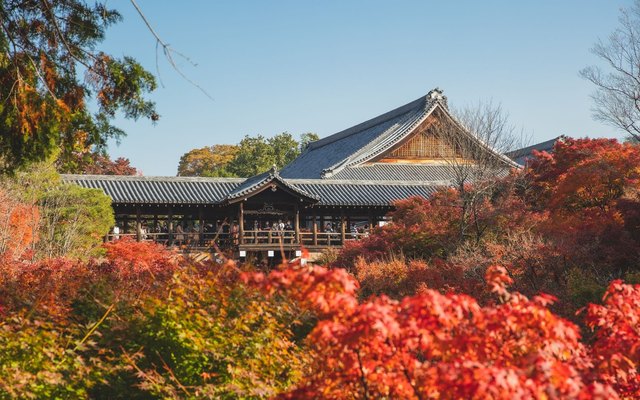
Between Kongobuji's front gate and the Garan runs the 蛇腹路, a lane that folds back on itself. The maples close over it, and for two or three weeks it is a red tunnel.
Kongobuji sits in the middle of the village, a short walk from the Garan on the same lane. Admission is ¥1,000, and the rock garden is the reason most people go in. The museum down the lane, the 霊宝館, is ¥1,300 and worth an hour when the weather turns.
Kongobuji 金剛峯寺
- Address
- 132 Koyasan, Koya-cho, Ito-gun, Wakayama 648-0294 · Map
- Phone
- +81 736-56-2011
- Hours
- 08:30–17:00, last entry 16:30
- Closed
- No closing day published
- Website
- koyasan.or.jp
The Okunoin approach starts at 一の橋 and runs 2 km to the 御廟, under cedars that are older than most of the graves, past more than 200,000 memorial stones. The lantern hall at the far end opens at 6:00 and shuts at 17:00, with the basement hall closing at 16:45.

Source: Wikimedia Commons · Reggaeman, CC BY-SA 3.0

Source: Wikimedia Commons · Daderot, CC BY-SA 3.0
Okunoin, Torodo 奥の院 燈籠堂
- Address
- Koyasan, Koya-cho, Ito-gun, Wakayama 648-0294 · Map
- Hours
- 06:00–17:00; the basement hall 06:00–16:45
- Closed
- No charge; the stamp office shuts earlier in winter
- Website
- koyasan.or.jp
The lantern hall holds sutra recitals through the day at 9:00, 10:20, 11:30, 12:40, 13:40 and 14:40, and anyone in the hall can sit through one. The stamp office at the far end keeps 8:00 to 17:00 from May to October and 8:30 to 16:30 from November to April, which decides whether a late-afternoon walk ends with a stamp.
The order that works is the halls first while they are empty, the 蛇腹路 at the end of the morning when the light comes through, then the Okunoin approach in the afternoon. The lantern hall shuts at 17:00, so the last stretch needs starting by about 15:00 if you want to reach the far end and walk back. Guided day tours from Osaka cover the same three stops in a fixed order, and they have you back in the city by the evening. Klook KKday
4The light-up and the last bus
The autumn lighting covers two places and no more, Kongobuji's front gate and the 蛇腹路. In 2026 it began on 20 October and runs until the leaves finish, a date the temple leaves open. The lights come on at 17:30 and there is no ticket for them.
The lighting began on 10 October in 2025 and 11 October in 2024, so the 20 October start in 2026 is a late year rather than a fixture. Read the temple's news page in the week before travelling instead of trusting last season's date.

Source: Wikimedia Commons · Captain76, CC BY-SA 3.0
The lit stretch is short. The front gate stands at the top of the lane and the lane folds away towards the Garan, a few minutes of walking with the maples lit from below. It rewards standing still more than covering ground, and the crowd thins after the first half hour.
The last bus from 金剛峯寺前 to 高野山駅前 leaves at 21:15 on weekday school days and 21:10 on Saturdays, Sundays and holidays. The last cable car down leaves at 21:40 on weekdays and 21:39 at weekends and on holidays, and the bus makes that connection. Nothing runs after those two, so a day trip that stays for the lights has to leave the tunnel by about 21:00. If you are sleeping on the mountain none of it applies, and the lit lane at 20:00 with nobody on it is the reason to stay.
5Sleeping in a temple
Of the 117 sub-temples, 51 take guests. They are spread through the village rather than gathered in one quarter, so the one you pick decides what you walk past at six in the morning. A night with two meals starts at about ¥20,000 a person.
The temple association runs its own booking site, which opened on 28 October 2026, and some temples still take bookings directly. Check-in is around 15:00, dinner at about 18:00, the morning service somewhere between 06:00 and 06:30, and you are out by 10:00. Curfews, bath times and meal times are set by each temple, so ask at check-in rather than assume. Pack as for a ryokan: toothbrush, soap and a yukata are usually in the room, and both meals are shojin ryori.

Source: Wikimedia Commons · Andrea Schaffer, CC BY 2.0
What the night buys is the morning. The lantern hall opens at 06:00, the approach is empty, and the first bus up from Osaka has not left yet.

Source: Wikimedia Commons · Flowizm, CC BY 2.0
6What a day costs
All figures below are per adult.
| What | Cost | What it covers |
|---|---|---|
| World Heritage ticket, counter | ¥4,210 | Return train, cable car, two days of village buses, coupon sheet |
| The same with a こうや seat out | ¥5,200 | The reserved seat on the way up only |
| Digital version | ¥3,980 | Same coverage, bought on the phone |
| Village bus day pass | ¥1,500 | Sold only at the 高野山駅前 bus office. Not needed if you hold either ticket above |
| Kongobuji | ¥1,000 | Junior high and up |
| Kon-do or Konpon Daito | ¥500 each | One hall at a time |
| Common ticket, five halls | ¥2,500 | The five halls on the temple's charge list |
| Reihokan museum | ¥1,300 | 09:00–17:00 |
| Temple lodging, two meals | About ¥20,000 and up | Per person, two meals included |
A day trip is cheap once the train is paid for. The ticket is ¥4,210, Kongobuji is ¥1,000, the Kon-do and the pagoda are ¥500 each, so a full day of halls comes to ¥6,210 including the travel. Swap the two halls for the common ticket at ¥2,500 and the same day reads ¥7,710.
Staying over changes the arithmetic rather than improving it. Add a bed at ¥20,000 to the same ticket and halls and the night lands near ¥28,000 a person. What it buys is time rather than entry, so the question is whether you want the Okunoin approach with people on it or without.
| Spot | What the maples do | When | Cost |
|---|---|---|---|
| Jabara-michi | The tunnel itself, maples closing overhead. The cover shot of every Koyasan autumn | A lane with no gate; lit from 17:30 | Free |
| Kongobuji front gate | The other lit spot, with the lane folding away from it | Lit from 17:30 | Free |
| Danjo Garan | Maples against the pagoda, and the Kon-do stair | 08:30–17:00, last entry 16:30 | ¥500 a hall, ¥2,500 for five |
| Kongobuji | The front gate from outside, the rock garden within | 08:30–17:00, last entry 16:30 | ¥1,000 |
| Okunoin approach | Cedars more than maples, with the lantern hall at the end | 2 km each way; hall 06:00–17:00 | Free |
7Questions and answers
When should I go for the leaves?
The last week of October and the first fortnight of November. The mountain runs ahead of Kyoto, and by the third week of November the colour is going over.
Is one day enough?
Yes, including the evening. The last bus leaves 金剛峯寺前 at 21:15 on weekdays and 21:10 at weekends, and the last cable car at 21:40 and 21:39. What a day trip cannot do is the lantern hall at six in the morning with nobody in it.
Which ticket should I buy?
The 高野山・世界遺産きっぷ at ¥4,210 covers the return train, the cable car and two days of village buses. The digital version at ¥3,980 does the same job and saves the queue at the counter.
Should I stay overnight?
Only if you want the morning. A temple bed with two meals starts at about ¥20,000 a person, and what it buys is the Okunoin approach at six, before the first bus arrives.
Keep reading


Sources
- Kongobuji (金剛峯寺), the estate's own account of the 117 sub-temples and the 51 that take guests (koyasan.or.jp/kongobuji)
- Kongobuji, the charge list for every hall: Kongobuji at ¥1,000, the Kon-do and the Konpon Daito at ¥500, the common ticket at ¥2,500, the Reihokan at ¥1,300 with its 09:00–17:00 hours, the opening times and last entry of each building, and the Okunoin lantern hall 06:00–17:00 with the basement hall to 16:45 (koyasan.or.jp/kongobuji/charges)
- Kongobuji, the 2026 autumn night lighting notice of 14 October: from 20 October until the end of the leaves, at the front gate and the Jabara-michi, with no end date set (koyasan.or.jp/news)
- Nankai Electric Railway, the 高野山・世界遺産きっぷ at ¥4,210, or ¥5,200 with the outbound こうや seat; the digital ticket at ¥3,980, or ¥4,910 with the seat; the return train, the cable car, two days of buses and the coupon sheet included (nankai.co.jp)
- Nankai Electric Railway, the こうや and GRAN 天空 schedule: Namba to Gokurakubashi in about 90 minutes (nankai.co.jp)
- Nankai Rinkan Bus, the one-day village pass at ¥1,500, sold only at the 高野山駅前 bus office; the fare table of March 2026 for ¥460 and ¥610; and the Kongobuji-mae timetable showing the 21:15 and 21:10 departures for Koyasan station (rinkan.co.jp)
- Nankai Electric Railway, the cable car timetable for Koyasan station: last departure 21:40 on weekdays and 21:39 on weekends and holidays (kensaku.nankai.co.jp)
- Wakayama Prefecture Tourism Federation, on the temples at about 800 m, the shukubo night from about ¥20,000 with two meals, the usual 15:00 check-in and 06:00–06:30 morning service, and the 10:00 checkout (wakayama-kanko.or.jp)
- Koyasan Shukubo Association, the official booking site and its opening on 28 October 2026 (koyasan-shukubo.net)
- Walkerplus, the 2026 Koyasan leaf page: 色あせ始め as of 20 November 2026, the 17:30 switch-on, the crowd peak of 10:00–15:00, and the normal late-October to early-November window for the Jabara-michi (koyo.walkerplus.com)
- Weathernews, the Koyasan leaf spot: a normal 見頃 of late October to mid-November (weathernews.jp)
- Wakayama Prefecture's spot listing for Okunoin: about 2 km from Ichi-no-hashi to the Gobyo, with more than 200,000 memorial stones along it (wakayama-kanko.or.jp)
- Fares, hours and fees are current as of 20 November 2026. The lighting has no published end date.