
Hita is a merchant town where the rivers that become the Chikugo meet and the man who drew Attack on Titan grew up. It answered with two museums, a bronze group under a dam wall and a statue at the station, and the two halves of the day sit on opposite sides of town.
- Museum
- ¥500
- Annex
- ¥700
- Both
- ¥1,000
- Hakata to Hita
- 1 h 25
1Why this town
Hajime Isayama is from Hita, and the city publishes the places that shaped him: the school he walked to with a schoolbag on his back, two barbers, the forestry school he rode to on a moped, and the merchant street that was his route.
Hita became shogunate territory in 1639, and its merchants' loans to the lords of Kyushu were known as Hita-gane. Ten and a half hectares of the old quarter have been protected since December 2004.

Source: Wikimedia Commons (CC BY-SA 4.0)
The two halves of the day sit ten kilometres apart, and one of them shuts at four.

Source: Wikimedia Commons (CC BY-SA 4.0)
2Getting to Hita
The town sits on the Kyudai Main Line, and the limited express from Hakata runs through without a change. The first of the day is 07:43, 08:25 at Kurume, 09:08 at Hita, an hour and 25 minutes. From Oita the same train works the other way, 08:20 out of Oita, 09:59 into Hita, an hour and 39 minutes. From Kurume alone, 43 minutes.

Source: Wikimedia Commons (CC BY-SA 4.0)
Three expresses each way are the Yufuin no Mori sightseeing sets, which call at Hita too, so the choice is the carriage. The fare is a standard JR one plus a limited-express seat ticket, and the IC card guide covers stored-value cards.

Source: Wikimedia Commons (CC BY-SA 4.0)
There is a highway bus too, and for a day out of the city it wins: the tourism association lists Fukuoka airport at an hour fifteen, Hakata at an hour forty and Tenjin at an hour thirty, all direct.
The last trains matter more here than in a city, because the next town is not a walk away. Toward Kurume the final departure is 21:08. Toward Oita the last through train is the 20:19, and after it the line reaches only Bungo-Mori at 20:56.
Hita station 日田駅
- Hours
- Ticket office 07:30–14:30 and 15:00–19:00 on weekdays; 07:30–07:55, 09:00–14:30 and 15:00–19:00 at weekends and on holidays
- Closed
- No closing days, with weekend hours over 13–15 August and 30 December–3 January
- Website
- jrkyushu.co.jp
3The walk through Mameda
Leave by the south exit and the first statue is already in the plaza. The old town is a straight walk inland: ten minutes to the Kangien site, nineteen to the brewery at the top of Uwamachi, and the street between them is the visit.

Source: Wikimedia Commons (CC BY-SA 3.0)
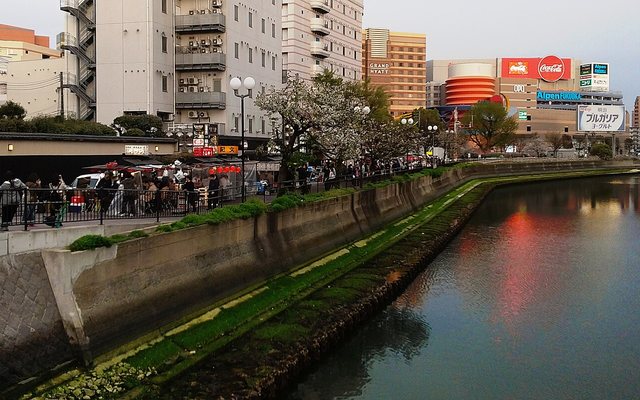
The grid is the oldest thing here: two north-south streets and five east-west ones laid out as a castle town in the early seventeenth century, still intact after three fires. The white and grey look comes from the rebuild, tiled roofs and earth-packed walls called igura-zukuri. Two of its buildings are national important cultural properties.

Source: Wikimedia Commons (CC BY-SA 3.0)
The manga route folds into the same walk. The author's spot list has Mameda as the street he rode to school, with his old barbers, the library and the school a short ride or a taxi hop off it. Mameda needs no vehicle.
Kangien site 咸宜園跡
- Address
- 2-13 Aso, Hita, Oita · Map
- Phone
- 0973-22-0268 (Kangien education centre)
- Hours
- Site 10:00–16:00; the centre next door 09:00–17:00 with last entry at 16:30
- Closed
- 29 December–3 January; the centre also closes on Wednesdays
- Website
- city.hita.oita.jp
The old town's industry is sake, and one brewery takes visitors without an appointment. Kuncho Shuzo at the top of Uwamachi keeps the second floor of its 1826 building open as a free museum: the pulley that hauled barrels upstairs, the press tubs, the hand tools. No booking, no admission, 09:00 to 16:30, never closed.
Kuncho Shuzo brewery museum クンチョウ酒造 酒蔵資料館
- Address
- 6-31 Mameda, Hita, Oita, in the Kuncho Shuzo brewery yard · Map
- Phone
- 0973-22-3121
- Hours
- 09:00–16:30
- Closed
- No closing days
- Website
- kuncho.net
4The museum and the annex across town
The permanent museum opened on 27 March 2021, inside the roadside station at Oyama, ten kilometres out on the road to the dam: original drawings, video and work from the author's childhood and student years. Adult admission ¥500, under 18 free.

Source: Wikimedia Commons (CC BY-SA 4.0)
Weekday hours are the trap: 09:30 to 16:00 Monday to Friday, 09:00 to 17:00 at weekends and holidays, and irregular closing days that follow the roadside station. Ring 0973-52-3630 first. No English labels are promised.
The annex is in town, on the Sapporo beer factory site at Takase: 10:00 to 19:00, ¥700, facsimiles from all 34 volumes with the author's commentary and childhood drawings, and a six-metre room with three screens opened in November 2023.
A combined ticket is ¥1,000 against ¥1,200 separately, valid on the day of purchase and the next business day, with re-entry. The second day is the useful part, because the two buildings are a short bus ride apart.
Attack on Titan in HITA Museum 進撃の巨人 in HITA ミュージアム
- Address
- 4106 Nishi-Oyama, Oyama, Hita, Oita, inside the Mizube no Sato Oyama roadside station · Map
- Phone
- 0973-52-3630
- Hours
- 09:30–16:00 on weekdays, 09:00–17:00 at weekends and on holidays
- Closed
- Irregular days, following the roadside station
- Website
- city.hita.oita.jp
Museum annex 進撃の巨人 in HITA ミュージアム ANNEX
- Address
- 6979 Takase, Hita, Oita, on the Sapporo Beer Kyushu Hita factory site · Map
- Phone
- 050-5370-0203
- Hours
- 10:00–19:00
- Closed
- Irregular days; shut over the New Year
- Website
- oidehita.com
5The bronzes, at a dam wall and a station plaza
Two bronze sites, neither on a riverbank. Eren, Mikasa and Armin stand as children at the Oyama dam, in front of the concrete wall the project treated as the Wall. Levi stands alone in the plaza on the station's south side, unveiled on 6 March 2021.
Both were paid for by fans: the town's promotion group began in 2019 as volunteers, crowdfunded the three children and then Levi, and became a council in 2021. The city puts the museum's economic effect at ¥1.6 to ¥2.05 billion a year over four years.
Getting to the dam is the hard part. The Takesue line bus leaves the terminal beside the station at 09:40, 10:45 and 14:05 on weekdays and Saturdays, and at 09:25 and 14:05 on Sundays and holidays: about 30 minutes to Nakawara for ¥460, or ¥920 return, then a 20-minute walk. The operator warns that the last outbound leaves you without a return bus.
A taxi does the same journey in 20 to 30 minutes for ¥3,000 to ¥4,500. A rented bicycle at the tourist information office covers the 10 km in 50 to 70 minutes for ¥700 for three hours or ¥1,000 for the day. Either way, the operator asks visitors not to leave offerings at the statues.
6What the town eats for lunch
Hita's local dish is a fried noodle cooked until the strands go crisp rather than soft, with bean sprouts keeping their bite. The tourism association keeps the shop list at its yakisoba research group.

Source: Wikimedia Commons (CC BY 2.0)
Sofuren is the shop the association credits as the birthplace of the dish, and its Oyama branch is on the official spot list with the author's signature on the wall. It sits on the road to the dam, so lunch on the way out. The promotion group's cafe, three minutes and 300 m from the station, serves a collaboration menu and is the only place in town openly about the series. The merchant street adds tea shops and a sake brewery shop.
7The order the day has to follow
The day is decided by three bus departures, one museum that shuts at four and a brewery that shuts at half past. The Takesue line leaves the terminal beside the station at 09:40, 10:45 and 14:05, which makes Oyama one excursion and leaves the old town the rest of the afternoon.
| Time | Where | Why then |
|---|---|---|
| 09:08 | Hita station | Off the Hakata train, bag in a coin locker |
| 09:15–09:30 | Station south plaza | The Levi statue, free and outdoors |
| 09:40–10:10 | Takesue line to the roadside station | ¥560, and the earliest bus of the three |
| 10:10–11:05 | Museum at Oyama | The weekday closing is 16:00, so it comes first |
| 11:15–11:45 | Return bus | 12:27 is the fallback, and the next is 15:46 |
| 12:00–13:00 | Lunch in town | The brewery museum shuts at 16:30 |
| 13:00–14:00 | Kangien | Ten minutes on foot, open 10:00–16:00 |
| 14:00–15:00 | Mameda | The street, end to end |
| 15:00–16:00 | Brewery museum | Free, and it shuts at 16:30 |
| 16:15–17:00 | Back to the station | Twenty minutes on foot from Uwamachi |
| 21:08 | Departure | The last train to Kurume |
The dam version swaps the middle of the day: the 09:40 or the 10:45 to Nakawara, the 20-minute walk to the statues, and the 12:31 back. The museum and the bronzes share one road, but their return times do not allow both. The annex is the third version, fifteen minutes out on the same line: it opens at 10:00, the last bus back from the factory is 16:02, and the 19:00 close needs a taxi waiting.

Source: Wikimedia Commons (CC BY-SA 4.0)
One caution on the last train: the 21:08 to Kurume is the end of the day, so a dinner past nine means a hotel. Hotels sit around the station and along the Mikuma. Amagase, the onsen, is a train stop rather than a walk.
8If you have half a day
Four hours buys the old town and nothing else: station, statue, ten minutes to Kangien, the length of Mameda, the free brewery museum, and back along the river to a train. The manga side is what you drop.
If the manga is the whole reason, invert it: a taxi from the station to the museum and the dam, the museum first because of the four o'clock close, and Mameda in the last hour before the 21:08. Two taxi rides at ¥3,000 to ¥4,500 each still beat a rushed version of both.
9Questions and answers
Tickets, buses, and whether the annex is worth a second stop.
How do I reach the statues without a car?
The Levi statue is in the plaza outside the station's south exit, free. The three childhood bronzes stand at the Oyama dam, 10 km out: the Takesue line bus runs three times a weekday, about 30 minutes to Nakawara for ¥460, then 20 minutes on foot. A taxi is ¥3,000 to ¥4,500.
What is the difference between the museum and the annex?
The museum at the Oyama roadside station holds original drawings and the author's childhood work and is the smaller of the two. The annex has facsimiles from all 34 volumes with his commentary, plus a six-metre immersive room. A combined ticket covers both for ¥1,000.
Can I see Hita as a day trip from Fukuoka?
Yes. The limited express leaves Hakata at 07:43 and reaches Hita at 09:08, and the last train back toward Kurume leaves at 21:08. A long day rather than a tight one.
How much does the manga side cost?
¥500 for the museum, ¥700 for the annex, ¥1,000 for both, and free for anyone under 18. The statues are outdoors and free.
| For the Hita trip | Why it belongs on this page | Check |
|---|---|---|
| Hotels around Hita station | Inside the walk, and the 21:08 train is the last one | — |
| Fukuoka hotel for the night before | The 07:43 leaves from a city you can be staying in | — |
| Kyushu rail pass | Three sightseeing expresses each way make the pass arithmetic real | — |
| Japan eSIM | The bus timetables and the museum's closed days are all online | — |
The rest of the line: Anime pilgrimage, town by town
Keep reading


Sources
- Hita City facility page: museum at 4106 Nishi-Oyama, 09:30–16:00 on weekdays and 09:00–17:00 otherwise, irregular closures, ¥500 adults and free under 18, 0973-52-3630 and the annex at 6979 Takase, 10:00–19:00, ¥700 and free under 18, 050-5370-0203 (city.hita.oita.jp/site/hitanioideyo/2866.html).
- Hita City preservation district page: 10.7 hectares designated 10 December 2004, the street grid, the fires of 1772, 1880 and 1887 and igura-zukuri, two national important cultural properties, and shogunate territory in 1639 with the 1767 promotion (city.hita.oita.jp/soshiki/29/2428.html).
- Hita City Levi statue page: unveiled 6 March 2021, plaza at 11-1 Motomachi on the south side of the station, and the crowdfunding behind it (city.hita.oita.jp/site/hitanioideyo/2464.html).
- Hita City Kangien page: 2-13 Aso, 10:00–16:00, closed 29 December–3 January, free, the centre next door 09:00–17:00 with last entry 16:30 and Wednesday closures, 0973-22-0268, and the ten-minute walk from the station (city.hita.oita.jp/site/kangien/17272.html).
- Attack on Titan in HITA official site: the dam wall as the Wall, the access table and Takesue line times, ¥460 and ¥920 to Nakawara with the 20-minute walk, ¥270 and ¥540 to the beer factory, ¥3,000–4,500 by taxi, cycle hire prices, and the request not to leave offerings at the statues (shingeki-hita.com/spot/).
- Its news page: combined ticket ¥1,000 against ¥1,200 separately, valid the day of purchase and the next business day with re-entry (shingeki-hita.com/news_2024.html).
- Hita City series page: the author's home town, the 2019–2021 promotion council, the museum's estimated economic effect from 2021 to 2024 (city.hita.oita.jp/site/hitanioideyo/1194.html).
- Hita Tourism Association: the annex at 10:00–19:00 with ¥700 admission and the six-metre room opened in November 2023 (oidehita.com/archives/58298, oidehita.com/archives/58777), the main museum's 27 March 2021 opening (oidehita.com/archives/50037), journey times from Hakata, Oita, Kurume, the airport and Tenjin (oidehita.com/access), and Hita yakisoba, with Sofuren as the birthplace (oidehita.com/archives/26490).
- Kuncho Shuzo brewery museum, 6-31 Mameda: 09:00–16:30, free, no closing days, 0973-22-3121, the 1826 building, 19 minutes on foot from Hita station (kuncho.net/shop/shiryokan.html).
- JR Kyushu: Hita station's ticket office hours, no closing days, coin lockers (jrkyushu.co.jp/railway/station/1191818_1601.html), the timetable for 21 November 2026, including Yufu 1 Hakata 07:43 to Hita 09:08, Yufu 2 Oita 08:20 to Hita 09:59, the 21:08 toward Kurume and the 20:19 and 20:56 toward Oita (jrkyushu-timetable.jp).
- Every fare, hour and closing day is current as of 21 November 2026. The museums close on irregular days, so ring before the trip.