Source: Pexels
Japan's largest restaurant site will hold a table for you without a word of Japanese on the phone. It also charges ¥440 for every person on the booking and takes a card before it confirms anything. What the score bands mean, what the fee covers, and the four screens between you and the table.
1What a Tabelog score means
Tabelog is the restaurant site Japanese diners use, run by Kakaku.com: about 890,000 listings, 92 million reviews and 245 million photographs. The English version carries the same restaurants and the same scores as the Japanese one — the words around them are machine-translated, which is worth remembering when a review reads oddly.
The score looks low if you are used to Google's averages, where everything pleasant sits above 4. Tabelog publishes the distribution itself: 4.00 and over is the top 0.07% of the country, 3.50 to 3.99 is the top 3%, and everything under 3.50 — about 97% of listings — shares one band. Filtering at 3.5 is not settling; it is asking for the top three per cent.
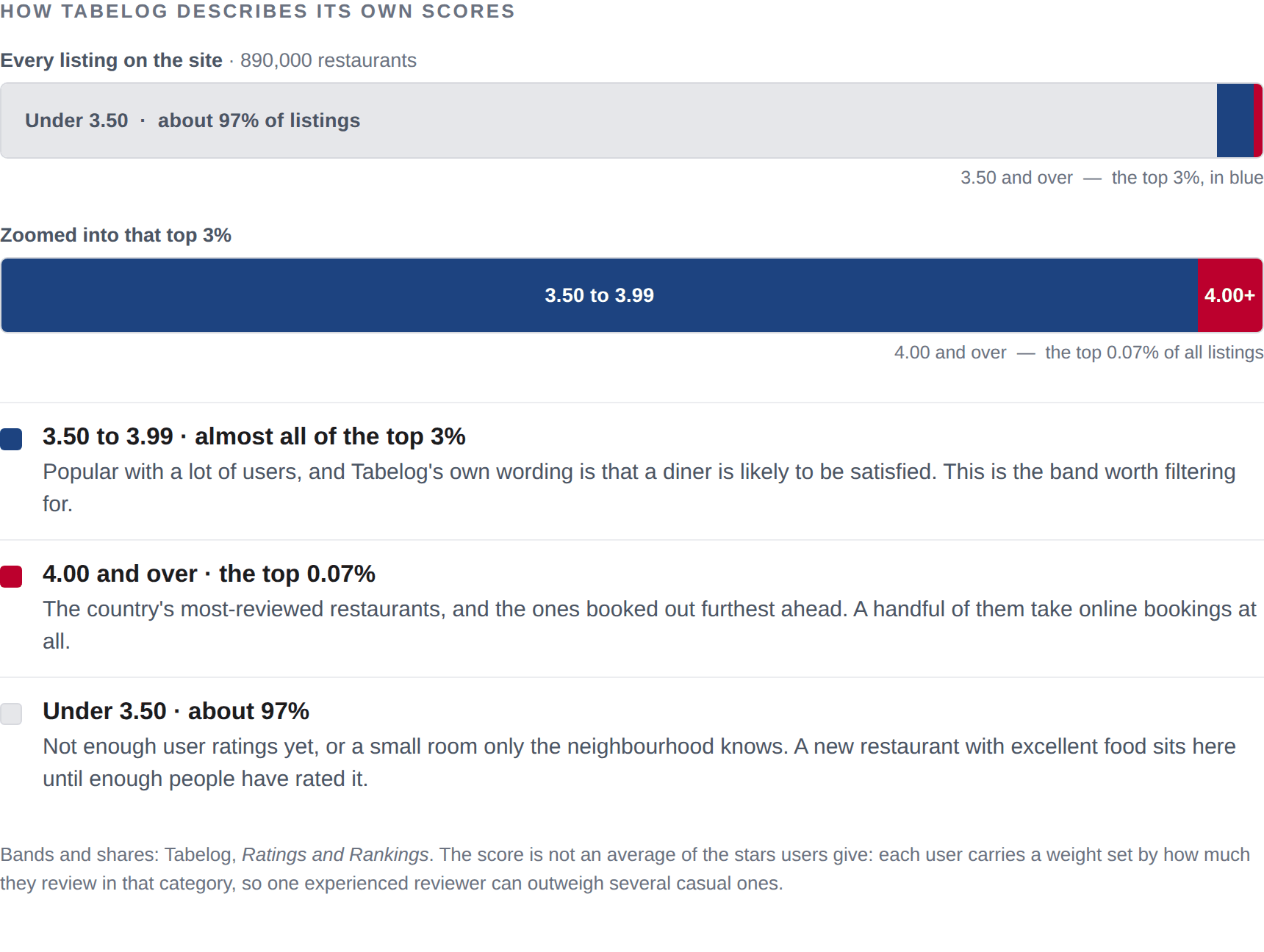
Illustration: Japan Trip Zero
Two things about the number decide how you should read it. First, it is not an average of the stars users give. Every reviewer carries an influence weight, calculated per category from how much they review in it, so one experienced reviewer can carry more than several casual ones — and people who work in the industry, food celebrities and anyone connected to Tabelog carry no weight at all. Accounts caught writing stealth marketing are excluded outright. Second, the score only rises once enough of those weighted ratings have accumulated, which is why a restaurant with a dozen reviews may show no score at all.
It also moves without new reviews: Tabelog recalculates on the first and third Tuesday of each month, so a place can lose two-tenths because a prolific reviewer's influence was re-measured rather than because it got worse. What money cannot do is buy the number: restaurants can pay for a better position in the default sort order, and Tabelog states plainly that this does not affect the rating. So a 3.62 is a restaurant that a lot of experienced users have rated well, and a 3.18 may be the same kitchen on a quiet street with thirty reviews.
2The app, and what it adds
Kakaku.com released the multilingual app on 17 November 2025 for iOS and Android; by 30 April 2026 it had passed two million downloads. It is free, browsing needs no account, and only booking does. It runs in English, Korean and Chinese (traditional); the website adds Thai and simplified Chinese. The translated layer covers the listing itself — the shop's own notes, the handwritten board and the staff's spoken menu stay Japanese.
Four things earn it a place on the phone on the day: a map search around wherever you are standing, a search by shop name when a sign is all you have, filters for average spend and private rooms, and a live look at seats still free that evening — the one job a website does worse. The saved list is worth using before you go: it is the difference between a plan and a queue.
Two of the sort orders are rankings of the same restaurants, and the difference decides what you end up eating. Most reserved by travelers counts bookings made through the English service and is ranked per language — it shows you what other English-speaking visitors have already found, which is useful and also a feedback loop. Most reserved by locals counts bookings made through the Japanese service, 14 to 8 days ahead. If you want the room rather than the crowd, read the second list and then check whether the restaurant takes an English booking at all.
Source: Pexels
Install it from Tabelog's own app page rather than from a search result, because that page carries both the App Store and the Google Play links; the app then takes its language from your phone. Everything it charges is on this page, not hidden in an app store listing.
3Booking a table, screen by screen
The English flow is four screens and about two minutes. Put three things in front of you first: an email address you can open on the road, a phone number you will still have in a fortnight, and a card in your own name. Nobody texts you a code; nobody asks for a Japanese address.
| Screen | What it wants | The detail that catches people |
|---|---|---|
| Date, time, party size | Availability, shown live | The calendar shows how far ahead that restaurant opens its book. Fridays and Saturdays, and the 18:00–20:00 sittings, go first. |
| The option | A course, or a seat only | A course is a set menu at a fixed price per person, and on the English service it is what most restaurants offer. Read what is in it before you commit; choose seat only and you order at the table. |
| Account | Email address, then a code from your inbox | A new account adds a name and a phone number. There is no SMS step and no Japanese number needed — managing the booking later just re-asks the number you typed. |
| Payment | A credit, debit or prepaid card in your own name | ¥440 × the number of guests is charged on this screen. Your bank may ask you to approve the payment, so have the app or the phone within reach. |
| Confirmation | An email with a 10-digit reservation number | Keep it. If nothing arrives, check the spam folder and allow mail from @tabelog.com — the booking exists either way, but the number is how you change it. |
| At the restaurant | The confirmation, on your phone | Show it and eat. The meal is paid at the restaurant, by whatever the restaurant accepts, and never through the app. |
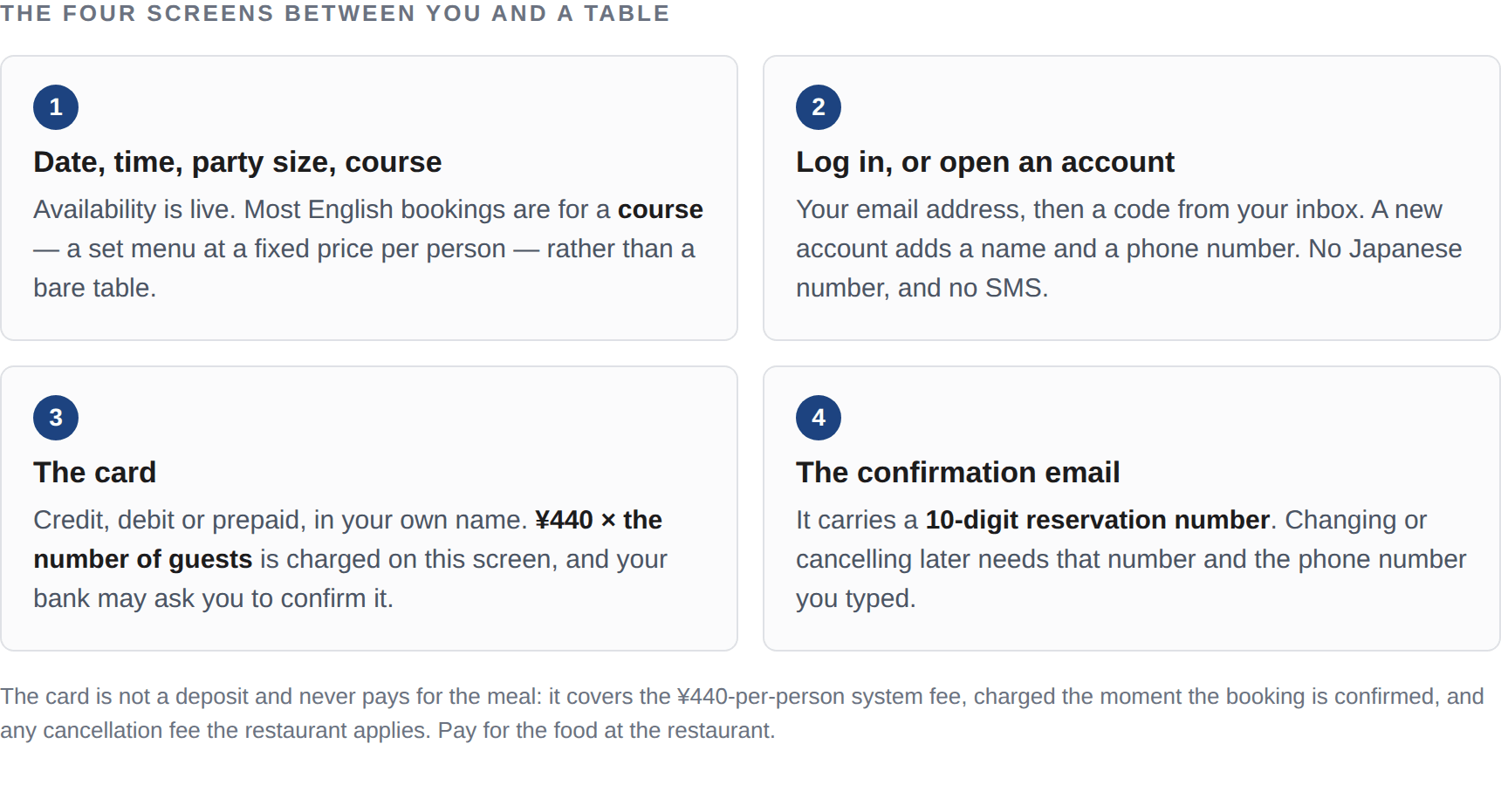
Illustration: Japan Trip Zero
What you are agreeing to is a contract with the restaurant, not with the app: the restaurant holds the table and sets the cancellation policy you will be shown before you pay. Tabelog runs the booking and the payment plumbing, and says so in its own terms — any argument about the meal itself, or about a booking, is settled with the restaurant.
4The ¥440 a head, and what the card is for
| Charge | How much | When it is taken |
|---|---|---|
| Tabelog system fee | ¥440 per person, tax included | The moment the booking is confirmed |
| Card check | about ¥2, on a card used for the first time | The same moment; refunded once the card is verified |
| Restaurant cancellation fee | Whatever that restaurant's policy says, up to the full course price | Only if you break the policy |
| The meal | The menu price | At the restaurant, on the day |
The fee is per head and it is not a deposit: it buys the booking itself, and it is charged whether or not you eat. A table for two costs ¥880 before anyone orders, a table for four ¥1,760. In other currencies it is whatever the day's rate makes it — the site's currency converter does that arithmetic.
Four rules follow from the same design, all of them in the reservation terms. Cancel for your own reasons and the fee is not refunded, whether or not the restaurant charges you anything on top. If the restaurant cancels on you, it is refunded. Cancel and book again and the fee is charged a second time. And if the party shrinks — four booked, two arrive — the fee is neither reduced nor refunded.
The card is registered for one reason beyond the fee: so that the restaurant can charge a cancellation fee if the booking goes wrong. It is never used for the food. That combination — no phone call, a card on file — is the whole point of the service, and Tabelog's own comparison for restaurants makes the trade explicit: the Japanese-language service takes bookings with no card and no per-person fee, while the inbound service requires a card and charges ¥440 a head. What the fee buys is the English flow, and the restaurant's protection against a visitor who does not turn up. Tabelog warns the amount can change without notice, so the confirmation screen is the figure that counts.
5Changing, cancelling, and the no-show
Both jobs run from the confirmation email: open the link, enter the 10-digit reservation number, wait for a second email, then type the phone number you booked with. The app's Reservations tab does the same thing with one login. Do the email route once at home rather than at 17:40 outside the restaurant; it is a chain of three messages.
Only the date, time and party size can be changed. The course cannot, and neither can anything else; for that you contact the restaurant directly. Tabelog does not pass requests — birthday plates, allergies and seat preferences are the restaurant's to answer, and its FAQ says so.
Each restaurant sets its own cancellation policy and shows it before you confirm. The deadlines are usually counted in hours or days before the sitting, and the fee can be the whole course price. Inside the deadline the restaurant may charge it, and Tabelog collects it on the restaurant's behalf from the card you registered. Turning up late, or with fewer people than booked, can both fall under the same policy. Not turning up at all, without cancelling, is the case the policy is written for: the restaurant decides, Tabelog merely bills, and a recorded no-show is not something Tabelog will argue about for you — its advice is to contact the restaurant, and only then to raise it through its contact form.
The single action that decides whether you pay anything is cancelling in the app as soon as plans change. Outside the policy's deadline it costs nothing, and it is also the reason the next English-speaker gets offered a seat at the same counter.
6Phone-only counters: the hotel desk, the Japanese pages, and walking in
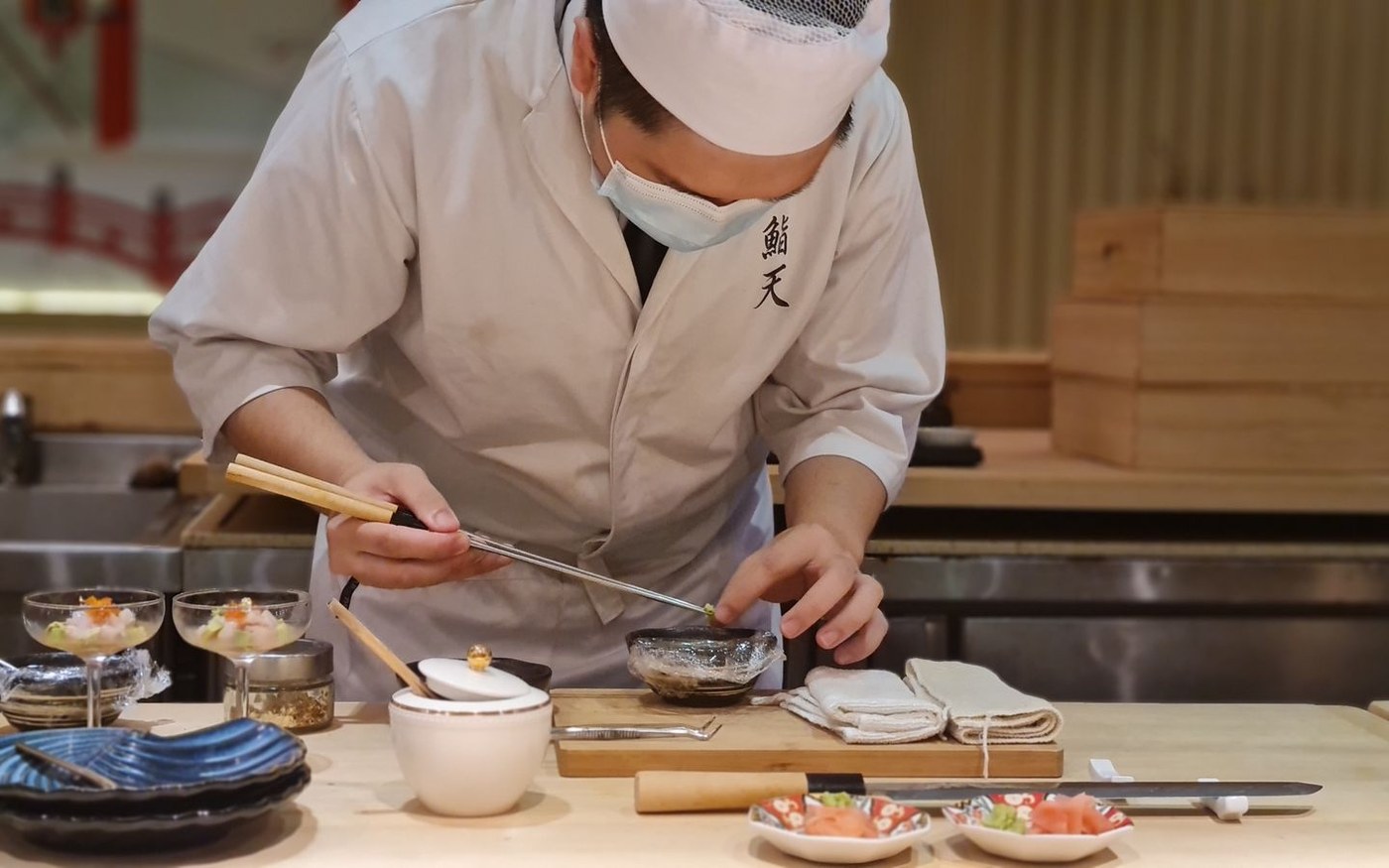
About one listing in ten takes online reservations: 96,000 restaurants are signed up to the booking service, against about 890,000 listings. The rest are phone-only, walk-in, or book through their own page, a Japanese-language site, or a hotel desk. The famous small counters tend to live in that second group — eight seats, one sitting, a phone number that rings in the kitchen.
The translated layer also drops details that decide whether the meal is worth it: the shop's own notes, the handwritten menu, the daily fish. And it will not show you a seat type at all. Booking a seat that carries a private-room charge is not possible on the English service, and choosing a seat type is not either; the Japanese service shows both. If the private room is the reason you are booking, this is the wrong door.
Source: Pexels
Four routes still work, in the order I would try them:
- Your hotel's front desk. Give them the name, the date, the time and the number of people, a day or two ahead. They will ring, it costs nothing, and a shop answers a hotel it knows more readily than a foreign mobile number. This is also how a Japanese-only booking site becomes usable, and the desk is usually happy to be asked.
- The Japanese pages. If seats show on the Japanese page but not in English, the restaurant simply has not opted in to the inbound service — there is no card and no ¥440 on that side. A browser translation gets most of the way through the form, which asks the same four things.
- Walk in. Plenty of counters seat walk-ins at opening or keep a list for the evening, and the ones with a queue are usually the ones worth queueing for. Go at opening rather than at 19:30.
- Book it once. Tabelog's terms prohibit more than one application in the same name for the same time slot, and the second booking holds a seat nobody is coming to. If you are not sure which channel worked, call the restaurant before adding another.
For the eating side of the same trip — what the street food costs, and which counters you can simply walk into — the Dotonbori guide is the worked example. For the other half of the problem, a room booked before you fly, the hotel guide covers what the plan actually buys.
7What I would do
- Install the app before you fly and finish the account there, with the card added. Filling in a booking form on a train, on airport wifi, is how a table for 19:00 becomes a table for 21:00.
- Search in English, then sort by Most reserved by locals rather than by what other visitors booked, and check that the restaurant takes an English booking before you fall for it.
- Treat 3.5 as the filter and 4.0 as a curiosity. Below 3.50 sits 97% of the country, including most of the rooms you will actually enjoy, so read how many people have rated it rather than the first decimal place.
- Book only the meals that matter. Every booking costs ¥440 a head whether or not you turn up, so three reservations you might cancel cost more than one you will keep.
- For a counter with no booking button, ask the hotel desk the day before, and keep walking in at opening as the fallback.
- Photograph the confirmation email and its 10-digit number. The change screen wants that number and the phone number you typed, and you will not have either in your head a week later.
- Cancel in the app the moment the plan moves — and if you are running late, ring the restaurant, because neither the app nor Tabelog will pass the message on.
Keep reading

Sources
- Tabelog (Kakaku.com) — English FAQ: making, changing and cancelling a reservation, the ¥440-per-person system fee, card rules and the ¥2 verification charge
- Tabelog — Terms of Use for the Tabelog Reservation Service for International Travellers: the fee, cancellation, the same-name rule and governing law
- Tabelog — Ratings and Rankings: how the score is calculated, the three published bands, the twice-monthly update and the effect of paid plans
- Tabelog — About Tabelog: listings, reviews, photographs and the number of restaurants contracted to online reservations
- Tabelog — Tabelog Multilingual App: languages, features and the official download links
- Tabelog restaurant-owner help — inbound reservations compared with the domestic service: card required, ¥440 a person, seat and private-room rules
- Kakaku.com — press releases: the 17 November 2025 launch of the multilingual app, and the two-million-download figure as of 30 April 2026